


AFP/Mumbai

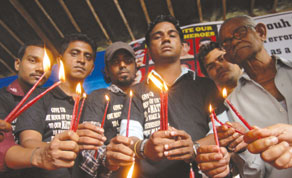
Mumbaikars hold candles to pay homage to the victims of Mumbai bomb blast and Mumbai terror attack in 2008 and protesting Ajmal Kasab’s appeal against his death sentence in Mumbai yesterday
The lone surviving gunman from the 2008 Mumbai attacks that left 166 dead has filed a case at the Indian Supreme Court asking for his death sentence to be overturned, a court source said yesterday.
The source said Mohamed Ajmal Amir Kasab had sent an appeal against his conviction and sentence via jail authorities in Mumbai, where he has been held since the attacks, which has been lodged with the court’s secretary general.
“He filed the appeal through the Arthur Road jail authorities,” the source said, asking not to be named.
Pakistani national Kasab, one of 10 Islamist gunmen who laid siege to Mumbai for nearly three days, was convicted by a trial court in the Indian commercial and entertainment capital in May 2010.
The first appeal by the 23-year-old school drop-out from a poor farming area in Pakistan’s Punjab state failed in February, when the state high court confirmed his death sentence.
Lawyer Ujjwal Nikam, who prosecuted the case in Mumbai, confirmed to AFP that “he (Kasab) has made the appeal proposal to the Supreme Court” without giving further details.
No one was immediately available for comment at the high security Arthur Road jail in south Mumbai, where Kasab is being held in solitary confinement.
One of Kasab’s legal team for his appeal to the Mumbai High Court in February, Farhana Shah, said that it was likely that her former client would be appointed a lawyer from the legal aid bench in New Delhi.
India has the death sentence, which is carried out by hanging, for the “rarest of the rare” criminal offences.
Kasab was found guilty of a string of crimes including waging war against India, murder, attempted murder and terrorist acts after a trial at a maximum security prison court in Mumbai.
During the trial, the prosecution produced fingerprint, DNA, eye-witness, CCTV and other evidence showing him opening fire and throwing grenades in the bloodiest episode of the November 26 attacks at Mumbai’s main railway station.
A number of senior police officers, including the head of the Maharashtra state anti-terrorism squad, were killed as the gunmen fled the scene of carnage.
Three luxury hotels, a popular tourist restaurant and a Jewish centre were also targeted by the other gunmen.
If the Supreme Court upholds the verdict and sentence, Kasab can appeal for clemency to President Pratibha Patil as a last resort.
Executions are rare in India. Instead, hundreds of convicts sit on death row awaiting a final decision on their pleas for clemency.
Afzal Guru, who was convicted of conspiring with the gunmen who attacked India’s parliament in 2001, killing 10 people, has been on death row for nearly a decade. His appeal against his death sentence was dismissed by the Supreme Court in 2006.
The last execution in India was in 2004 when a 41-year-old former security guard was hanged for the rape and murder of a 14-year-old schoolgirl.
In May this year, however, Patil unexpectedly rejected a mercy petition from a murderer in Assam, leaving the state scrabbling to find a hangman. Many of the small number of known hangmen nationwide have either died or retired in recent years.
India has accused the banned, Pakistan-based Islamist group Lashkar-e-Taiba of being behind the 2008 Mumbai attacks, which led to the suspension of fragile peace talks between the two neighbours and rivals.
Mumbai blasts toll mounts to 25
The death toll from the July 13 triple bomb blasts in the Indian city of Mumbai has risen to 25 after a critically wounded man died in hospital, police said yesterday.
The 48-year-old died on Thursday at the private Saifee Hospital, the officer leading the investigation, said Rakesh Maria of the Maharashtra state anti-terrorism squad.
Indian newspapers said the man, a diamond broker, suffered horrific injuries to his legs and infection led to a fatal heart attack.
No one was immediately available for comment at the hospital.
Five of the wounded have now died in hospital in less than a week. Two, including the latest victim, were hurt at Opera House, while two others were caught in the explosion at the Zaveri Bazaar gold and jewellery quarter.
The fifth died on Monday of wounds he sustained in the blast at a bus stop in the suburban district of Dadar.
Three home-made bombs packed with the fertiliser ingredient ammonium nitrate and detonated by timer devices exploded during rush hour. More than 130 people were wounded in the blasts.