


Agencies/New Delhi
Prime Minister Manmohan Singh yesterday hailed the country’s success in slashing new HIV/Aids infections by half in the past decade.

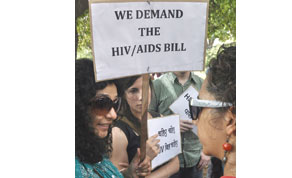
Protesters stage a demonstration outside the health ministry in New Delhi yesterday demanding that an HIV/Aids bill be presented in the parliament
“Our HIV/Aids programme can justifiably claim a measure of success,” he told a conference in New Delhi on the disease, but added “there should be no room for complacency” with an estimated 2.3mn Indians still living with HIV.
“With the introduction of antiretroviral treatment, HIV has become a chronic but manageable health condition,” Singh said.
“India’s testing and treatment for HIV/Aids have increased their reach,” Singh said.
Now, Indian health workers are focusing on prevention of transmission from infected pregnant women to their newborn children, making it a “priority area,” Singh said.
India’s Aids control programme has reduced new HIV/Aids infections by 50% in the last 10 years and mortality rates amongst those infected with HIV have also fallen, Singh noted.
Indian pharmaceutical companies have helped to drive down the cost of life-saving generic drugs to treat people with HIV in India and other developing countries.
Singh said one of India’s key strategies has been to scale up preventive education campaigns among high-risk groups such as sex workers.
Unprotected sex, particularly between sex workers, their clients and partners, is the main factor behind the spread of the disease, UNAids says.
Contaminated needles also play a key role in spreading the virus in India’s northeastern regions, the UN agency says.
Singh said there should be no discrimination in India against people living with HIV, condemning frequent denial of school admission to children with the virus.
“We must see that there is no social ostracisation,” he said.
He also urged the global community not to slacken in its fight against what called “one of the biggest health challenges confronting humanity.”
But while Singh was praising government efforts to combat the virus, around 100 people living with HIV protested outside the ministry of health saying efforts were insufficient.
So-called “first-line” antiretroviral therapy (ART) - a cocktail of drugs to slow the effects of the virus on the body’s immune system - has been widely available and free of charge in India’s public health system since 2004.
But more expensive “second-line” ART is also free, although access to it is limited to just a few centres across the country.
The protesters also demanded that a bill to protect the rights of people living with HIV/Aids be introduced in the monsoon session of parliament.
At present the bill is with the health ministry.
Sahil from the Om Prakash Network of Positive People said: “The bill is very important as it puts an obligation on the state to provide complete treatment, diagnostics and nutritional supplements to all HIV positive people.”
In August 2007, the HIV/Aids bill prepared by the health ministry was sent to the law ministry and in March 2010, the law ministry cleared the bill. Since then, the bill is pending with the health ministry.
“We are not sure why the health ministry has become so indifferent towards passing of this bill ever since the law ministry cleared it,” an organiser of the protest said.