


AFP/New Delhi
More women than ever are holding powerful political roles in India after two female regional leaders scored massive victories in state assembly elections.

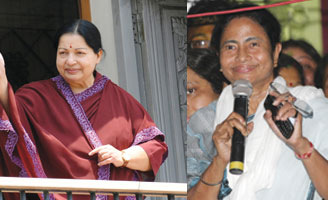
Jayalalitha (left) and Banerjee: on centre stage
Their wins doubled the number of female state chief ministers and meant that women now rule a third of the 1.2bn population in India, where girls are often still seen as a liability and female foeticide has skewed gender ratios.
The country, which already had a sprinkling of women in key positions including Sonia Gandhi, chief of the ruling Congress Party, is seeing an unprecedented “burst of feminine power,” said veteran commentator M J Akbar.
Firebrand Mamata Banerjee last week demolished 34 years of communist rule in West Bengal, India’s fourth most populous state - prompting the Indian Express newspaper to shout in a headline: “Bengal makes herstory.”
Meanwhile, in Tamil Nadu, ex-movie actress J Jayalalitha staged a huge comeback to oust the Dravida Munnetra Kazhagam party enmeshed in corruption allegations.
The pair join populist maverick leader Mayawati, the chief minister of Uttar Pradesh, and Delhi Chief Minister Sheila Dikshit, regarded as a sober grandmotherly type.
“There is definitely a big electoral sweep in favour of women,” Rekha Aggarwal, a Supreme Court lawyer and women’s activist, said.
“For generations, women have been downtrodden. It’s a big signal to male politicians who’ve been ruling the roost,” she said.
While Sonia Gandhi, 64, is viewed as India’s most influential politician, women also hold the jobs of president, leader of the opposition and parliamentary speaker.
Last year, the Rajya Sabha, the upper house of parliament, passed long-standing legislation that would reserve a third of seats in the parliament for female MPs, but it is yet to go to a vote in the Lok Sabha, the lower house.
Observers are divided on what the surge in female power means - and what it could bring in a nation plagued by accusations of high-level corruption.
“People are voting this way because they think women will be more responsible and less corrupt as political leaders than male politicians,” said Aggarwal.
However, among the chief ministers, only the diminutive Banerjee, 56, who favours plain cotton saris and lives with her elderly mother in a modest one-storey home, is free from any whiff of scandal.
Jayalalitha, 63, who has a strong following among the rural poor, has battled court charges of enriching herself at public expense and had a reputation as a vindictive politician during previous stints in power.
The pugnacious Mayawati, 55, has in the past received garlands of bank notes at public events and stirred controversy by building vast “statue parks” of low-caste icons - using public money that critics say would be better spent on hospitals and schools.
The reputation of Dikshit, 73, was damaged by accusations of mismanagement and corruption by her administration over last October’s shambolic, costly Commonwealth Games.
So to suggest women politicians might be more responsible than men is “contrary to all prevalent evidence,” said Akbar.
Observers also say the move to political centre-stage does not automatically signal better times for women in the wider population, who are commonly victims of domestic violence and battle second-class status with lower health and literacy rates.
Mayawati was first elected 16 years ago and “there’s no evidence her rule has improved the situation of women,” said Zoya Hassan, politics professor at New Delhi’s Jawaharlal Nehru University.
Analysts do agree that the election results could create new headaches for the Congress government, already reeling from corruption scandals.
Congress dominated as a national force in Indian politics for decades, but now the country is a multi-party patchwork where regional politicians can wield major influence.
In a harbinger of potential trouble, Jayalalitha branded Prime Minister Manmohan Singh a “weak-kneed head of state” and blamed him for India’s corruption woes.
Banerjee’s Trinamul Congress Party already sits in the national ruling coalition dominated by Congress, but her victory in West Bengal’s state elections will give her more prominence.
She looks likely to emerge as a more potent but unpredictable force in New Delhi politics, analysts add.
“In the exercise of power, they (India’s women leaders) let ruthless efficiency trump any expectation of genteel compassion... unleashing fury that even hell does not contain,” commented the Economic Times newspaper.