


Agencies/New Delhi
Election results due tomorrow are expected to give a boost to the embattled Congress, according to exit polls, with the ruling party and its allies tipped to win in at least three of five states.

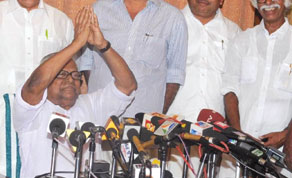
Kerala Chief Minister V S Achuthanandan says goodbye to reporters in his typical style after the last meeting of his cabinet in Thiruvananthapuram yesterday
The surveys show firebrand politician Mamata Banerjee’s Trinamul Congress, in alliance with the Congress, is set to deliver a crushing defeat to the world’s oldest democratically elected Communist government in West Bengal.
The findings by AC Nielsen gave Banerjee’s coalition 215 of the 294 assembly seats that would end 34 years of Soviet-style economic management of the eastern state.
Banerjee, the federal railway minister, who casts herself as a champion of the poor, has ridden a wave of popular discontent with the Left Front government’s handling of the economy that has left industry in decline and the state neck-deep in debt.
Her win would give the federal coalition led by Prime Minister Manmohan Singh a lift at a time when it is reeling from a slew of corruption scandals, including a high-profile telecom graft case, and surging inflation.
Results from West Bengal, Tamil Nadu, Assam, Kerala and the union territory of Puducherry over the past month are due to be released tomorrow.
The voting has been seen as a mini-referendum on the popularity of Singh, 78, and his government.
In Kerala, most surveys published in the media tipped the Congress-led United Democratic Front to oust the Communist Party of India (Marxist)-led Left Democratic Front government.
But in Tamil Nadu, most polls projected the fall of the incumbent Dravida Munnetra Kazhagam (DMK), a key Congress ally, and victory for the All India Anna Dravida Munnetra Kazhagam (AIADMK) opposition led by former chief minister J Jayalalitha.
DMK leader and former telecom minister A Raja is in jail over a mobile licensing scandal alleged to have cost the national treasury up to $40bn in lost revenues.
In northeastern Assam, a poll published in the Times of India indicated Congress would narrowly retain power.
There were no surveys on the outcome of elections in Puducherry, but before the vote analysts gave Congress the edge.
The elections will signal the political temperature in states that jointly make up a fifth of the 545-strong Lok Sabha, lower house of parliament, and will help redraw the political map ahead of federal elections in 2014.
With neither of the main national parties, Congress and the opposition Bharatiya Janata Party (BJP), able to secure majorities in general elections, electoral power in India comes down to forging coalitions with regional allies.
“Piggybacking has never worked for Congress, they are only weakening their own foundation,” said N Bhaskara Rao, chairman of New Delhi-based think tank Centre for Media Studies.
“Instead of the coalition having once-a-month problems, you’ll now have once-a-week problems.”
Singh’s government has been considering lifting controls on diesel and fertiliser prices and streamlining a bloated food subsidy programme, but these measures are politically unpalatable given inflation is at nearly 9%.
Analysts expect hard resistance from Banerjee’s party when Singh’s cabinet sits down to take decisions on paring down the subsidy bill, which forms more than a tenth of total spending.
“She’ll have to maintain her populist image,” said political analyst Mahesh Rangarajan.
But Rangarajan, like other analysts, did not expect her to rock the coalition, given that a Trinamul government in West Bengal would need federal support in terms of funds.
Rising tax revenue from an economy powering away at close to 9% has long let India avoid taking hard decisions on slashing expenditure, including subsidies on food, fuel and fertilisers that supporters say are needed to protect India’s half-a billion mostly rural poor from inflation.
But growth this year is expected to slow down to 8.5%, weighed down by the nine rate hikes since last March effected to curb inflation.
“The government will find it difficult to push through the kind of reforms they were planning,” said D H Pai Panandikar, head of New Delhi-based think tank RPG Foundation.
“Fiscal consolidation will be more of technical rather than from reforms ... the fiscal deficit is likely to go up, everything is built on 9% (growth).”
Congress is aware of the challenges facing it.
“Various parties within the (coalition) may have different view points. That doesn’t mean any political party has a veto on policy, one way or the other,” said Congress spokesman Manish Tewari.
Some losses may not be bad in the longer term. An ouster from power in Tamil Nadu will make the DMK more dependent on Congress and less likely to oppose reform policies at the federal level.