


Agencies/Puttaparthi
Spiritual leader Sathya Sai Baba, followed by millions of people worldwide, was buried with full state honours in an extravagant funeral service yesterday.

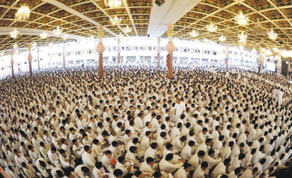
Devotees gather inside the Kulwant Hall in Prasanthi Nilayam to attend the funeral ceremony of Sathya Sai Baba yesterday
Huge crowds of devotees gathered outside his ashram in the southern town of Puttaparthi as he was interred under the marble podium where he gave many of his teachings.
While cremation is the most common practice at Hindu funerals, he was buried in the custom accorded to Hindu holy men.
Sai Baba was given a gun salute before his body was prepared for burial by 18 priests dressed in saffron robes who anointed him with oil, flowers, cow urine and water from nine holy rivers.
As the chanting of sacred Hindu texts filled the air, his nephew performed the last rites and the body was then lowered into the ground behind a red curtain.
Christian, Islamic, Sikh and Buddhist scriptures were also read out, and a decorated cow brought in to be donated to the priests.
The scenes were broadcast live on television, with screens erected in Puttaparthi so the faithful could bid a final farewell to their charismatic guru, who died of multiple organ failure on Sunday aged 85.
Since his death, Sai Baba’s body has lain inside a transparent casket on view to grieving devotees including poor villagers, foreign pilgrims, tycoons, politicians and cricket stars such as Sachin Tendulkar.
On Tuesday, Prime Minister Manmohan Singh and ruling Congress chief Sonia Gandhi, visited the ashram to pay their last respects.
The funeral was witnessed by 15,000 invited guests - relatives, members of the Sai Baba Trust, dignitaries and faculty members from the many educational institutions funded by the trust.
The grave was filled up with earth, salt, gold, silver and gems.
After the funeral, the ashram was opened to the public and long queues formed to view the burial spot, which is likely to become a major pilgrimage site.
A gold-plated statue of Sai Baba in a standing posture with his right hand raised is planned as a memorial.
Sai Baba, who was credited with supernatural powers by his followers in India and abroad, used donations to build an empire of free hospitals, schools, clinics, prayer centres and other properties and assets.
Instantly recognisable by his wild curly hair, he had ashrams in 126 countries and his trust, which has often been criticised for lack of transparency, is estimated to be worth up to $9bn.
Puttaparthi has grown from a village into a major religious town, boasting a university and even an airport as Westerners, Indian students and the destitute clamoured to be close to a man they saw as a living god.
As well as hospitals and clinics, the Sai Baba organisation operates drinking water schemes, a museum, a planetarium and an international network of prayer rooms.
At public meetings, his showman antics - in which he would miraculously produce gold coins or watches on stage - brought him both fame and notoriety, with critics accusing him of being a fraudster.
He also faced allegations of sexual abuse of young male followers, which his opponents said were ignored by Indian authorities due to his power and popularity.
Sai Baba, when he was 14, announced himself to be the reincarnation of a former holy man, Sai Baba of Shirdi, who died in 1918, and many of his followers believe he will also be born again.
The future of his hugely wealthy trust is uncertain and some observers predict a power struggle among his closest aides.