


Agencies/Mumbai
Mobs attacked a hospital and blocked a highway in Maharashtra yesterday in a second day of violent protests against a planned nuclear power plant, after a protester was shot dead a day earlier.

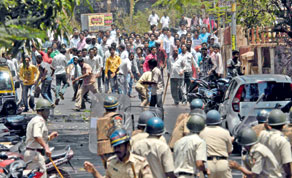
Protesters clash with police in Ratnagiri during protests against the planned nuclear power plant in Jaitapur
The renewed violence prompted police to ban large public gatherings and political rallies, television channels reported, with anger seething over the proposed power station amid Japan’s nuclear emergency.
A furious crowd targeted a hospital in Ratnagiri town, while state transport buses were pelted with stones and a district highway road blocked with burning tyres.
The rightwing Shiv Sena party called a shutdown in Ratnagiri town, 350km south of state capital Mumbai.
Five demonstrators were taken to hospital with bullet wounds, and at least six policemen were injured, the administration head in Ratnagiri said.
“The situation is calm and under control,” a police official at the Ratnagiri police control room said, asking not to be identified.
Anger has been brewing in the area since Environment Minister Jairam Ramesh last week ruled out a “rethink” on the planned six-reactor, 9,900-megawatt facility in Jaitapur in Ratnagiri district.
On Monday police shot a man dead during clashes with protesters, later saying they had “no choice” but to fire live bullets at the crowd.
“We will not stop these protests or take custody of the dead body or allow his postmortem till (Chief Minister) Prithviraj Chauhan brings the Jaitapur project to a halt,” CNN-IBN quoted a Shiv Sena party leader as saying.
Demonstrators set a police station ablaze after the killing, and at least 20 were arrested.
The power plant is to be constructed with technical help from the French energy giant Areva.
But environmental campaigners argue the location is prone to earthquakes, while local people who are dependent on fishing and farming say the plant will rob them of their livelihoods and nuclear waste could pollute the soil and sea.
Nuclear industry insiders have also cast doubt on India’s ability to deal with a crisis on the scale of that faced by Japan at its Fukushima Daiichi plant after a devastating earthquake and tsunami last month.
Ramesh said the government’s opponents were whipping up opposition and India had no option but nuclear power.
“They have just made this a political issue,” he told the Times Now news channel, referring to the Shiv Sena party.
“What happened in Jaitapur is most depressing. It caused me great anguish. There is a form of democratic protest, which we must all accept and acknowledge. But firing and people dying is unacceptable in democracy,” Ramesh said.
Slamming the Shiv Sena, Ramesh said: “They have no issue so now they are politicising Jaitapur. I have written a letter to the prime minister about the safety of nuclear power plants. The central government and the atomic energy board are looking into these issues.”
Ramesh had written to Prime Minister Manmohan Singh seeking a rethink of safety of nuclear projects after the Fukushima nuclear disaster.
“The Shiv Sena has a long track record of politicising all issues. This is the same Shiv Sena which vowed to throw the Enron Project in the Arabian Sea in 1993 if I recall right. But they came to power in 1995, they went out of their way to give approval. In fact they gave approval in unholy haste to the Enron Project. What does the Shiv Sena stand on, I don’t understand,” he said.
“I have said it before and say it again, apart from nuclear energy we have no other choice.”
The ruling Congress Party expressed regret over the killing but wondered if the violence was being fuelled by “imaginary concerns”.
“The death of a person in police firing is always regrettable,” party spokesman Manish Tiwari said.
“What has to be seen is whether the agitation is based on some real concerns or (if) completely imaginary concerns are being stoked by vested interests,” he added.