


AFP/Jaipur
Huge crowds gathered in the city of Jaipur yesterday to bid farewell to one of the country’s last maharajas, who was cremated with full state honours after an elephant parade.

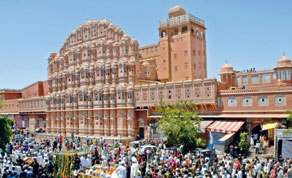
The funeral procession of Bhawani Singh pass by the ‘Hawa Mahal’ (Palace of Winds) in Jaipur yesterday
Bhawani Singh, the last maharaja of Jaipur, died at the age of 79, prompting two days of mourning in the ancient city which is famous for its pink architecture and imperial palaces.
Singh, who held a brigadier’s rank in the Indian army and was feted as a war hero, passed away on Saturday suffering from multiple organ failure after being hospitalised about three weeks ago, his relatives said.
His body was cremated in the open on a pyre of wood lit by his grandson in line with Hindu religious traditions. The cremation was broadcast live on television during several hours of coverage.
The funeral cortege had earlier moved through the walled city accompanied by bejewelled elephants and horses, as attendants threw holy rice into the ranks of mourning citizens.
The maharaja’s death cut one of the few remaining links to an era when local royal families controlled large swathes of India, often enjoying lives of great extravagance.
Jaipur was one of many “princely states” designated by British colonial powers, who imposed indirect rule by signing alliances with Indian royal families.
After independence in 1947, the maharajas gradually lost power and influence particularly during government reforms in the 1970s, but local people have often continued to view them as their leaders.
Early in the day, soldiers belonging to Bhawani Singh’s paratroopers’ regiment carried his body, draped in military uniform, to the ornate Chandra Mahal city palace.
State ministers and thousands of Jaipur residents paid their respects at the palace as government offices shut down and the Indian flag flew at half-mast across the western state of Rajasthan.
Singh’s body was then put on a gun carriage and driven in a procession of caparisoned elephants and horses to the royal crematorium, where priests chanted ancient Hindu scriptures as his body was burnt.
The 40th maharaja of Jaipur took the throne in 1970 following the death of his father, Man Singh. A year later, India abolished all royal titles and removed their privileges. Many families have since remained hugely wealthy, though some of their numerous palaces have been converted into luxury “heritage hotels”.
Jaipur was among the richest royal estates, and the city remains one of India’s biggest tourist attractions.
Singh, who belonged to the Rajput warrior caste, was decorated with the country’s second highest military award, the Mahavir Chakra, for his role during India’s second war with Pakistan in 1971.
During the fighting, Singh was said to have duped Pakistani troops into believing that a large formation of Indian tanks was advancing on their position while in reality the vehicles were simply noisy jeeps.
After his retirement from the army, Bhawani Singh unsuccessfully contested parliamentary elections in 1989.
Singh, who studied at Britain’s Harrow School and also served as ambassador to Brunei in the 1990s, is survived by wife Padmini Devi and daughter Diya Kumari.
His glamorous step mother, Gayatri Devi, once named as one of the most beautiful women on Earth by fashion magazine Vogue, was accorded a similar royal funeral in Jaipur following her death at the age of 90 in July 2009.