


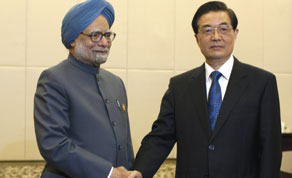
Reuters/Sanya, China
India and China have agreed to restore defence ties and will exchange visits by their top leaders as well as take steps to enhance their balance of trade, India’s National Security Adviser Shiv Shankar Menon said yesterday.

Prime Minister Manmohan Singh is greeted by Chinese President Hu Jintao in Sanya in Hainan Province yesterday
The two will also set up a consultation mechanism for a long-running border dispute, Menon said, in a sign that the Asian giants are willing to sidestep contentious issues to align with each other on global platforms like the G20.
India and China suspended military ties last year after Beijing denied a visa to an Indian army general from Kashmir. India also has broad suspicions about China’s close relationship with Pakistan.
But Menon described a 50-minute meeting between Prime Minister Manmohan Singh and Chinese President Hu Jintao ahead of a summit of emerging powers in the southern Chinese resort of Sanya as “very productive, warm, friendly.”
The two sides reached in principle agreement on establishing a “working mechanism for consultation and co-ordination on border affairs,” he added.
“This will handle important border affairs relating to maintaining peace and tranquility,” Menon said, though he added that “in practice it is one of the most peaceful borders that we have.”
The two fought a brief border war in 1962, and several rounds of talks on the subject over the past few years have made little real progress.
More broadly on defence ties, Menon said that a multi-command Indian Army delegation would visit China later in the year.
Asked whether that might mean joint exercises at some point, he answered: “It could certainly. We’ve done so in the past and we’ll probably do so in the future.”
Singh also accepted the Chinese president’s offer to visit China soon, a gesture which was also reciprocated by Singh and accepted by Hu, Menon said.
Trade relations have proved tricky too. India has been peeved that the relationship is heavily in China’s favour and has worried that China might use India as a dumping ground for cheap manufactured goods.
“The PM spoke of taking our relationship to a higher level, focusing more on cross-investment, and also spoke of China providing better market access for Indian exports, particularly in IT, pharmaceuticals, agricultural products and in the engineering sectors,” Menon said.
The Indian government has asked its trade ministry to come up with a list of specific sectors where India has been seeking better market access from China. China is also expected to come up with a similar list.
As part of a drive to boost trade and investment, China and India are today expected sign an agreement to extend mutual credit lines denominated not in dollars but in the BRICS’ local currencies, a source in India’s finance ministry said.
India and China, along with Brazil, Russia and South Africa, the other members of the “BRICS” countries, hold a formal summit in Sanya today.
The issue of the inclusion of the Chinese yuan in the basket of currencies which comprise the SDR, an internal accounting and monetary unit of the International Monetary Fund, will also come up for discussion at the formal BRICS talks, Menon said.