


IANS/New Delhi
Join the peace process to solve Kashmir’s problems or get isolated - that is the message from federal Home Secretary G K Pillai to separatist leaders in the northern state who have so far refused to be part of the dialogue initiated by the government last year.

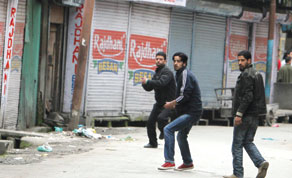
Protesters throw stones at police during a clash at a closed market in Srinagar yesterday. A two-day strike called by separatists to protest against the assassination of a leading cleric shut down much of Kashmir
“It is up to them (separatists) if they want to be a part of the peace process; otherwise they will get isolated,” Pillai said in an interview.
Both the hardline and moderate factions of the separatist All Parties Hurriyat Conference headed respectively by Syed Ali Shah Geelani and Mirwaiz Umar Farooq have so far refused to be part of the dialogue process the government set in motion last year after months of bloody street protests in the Kashmir Valley.
They even refused to meet the government-appointed interlocutors tasked to suggest a way forward on how to find a political solution to the issue of Jammu and Kashmir, a state battling an unending separatist war since 1989 that has left some 70,000 people dead.
The top bureaucrat, responsible for managing the country’s internal security-related issues, said the government won’t invite militant leaders for talks “unless and until they give up arms.”
“Militancy is down in Kashmir, every day you must be reading reports that some militant leader or the other has been killed. I think the Hizbul Mujahideen has literally, almost, been wiped out, especially the Pakistan element of it has been wiped out,” Pillai said.
The largest Kashmiri guerrilla group has been “almost” vanquished now and if the militant leadership based in Pakistani Kashmir wants to join the peace process, they can, Pillai said.
He said the government had no proposal for now to extend talks offer to Kashmiri militant leadership based in Pakistan-administered Kashmir, especially to Syed Salahuddin, the Hizbul Mujahideen chief who also heads the United Jehad Council (UJC), a conglomerate of over a dozen terror groups operating in Jammu and Kashmir.
“If (he) Salahudin wants to come and talk, he is welcome if he gives up violence. We are not saying no to anybody. He has to come here and talk. Nobody is going there to talk to him,” Pillai said.
Asked why the government was reluctant to take militant leaders onboard the peace process, Pillai said: “There are less than a hundred local militants (in Kashmir). Nobody would even talk to them. They don’t represent anybody.”
Pillai said the interlocutors - Dileep Padgaonkar, Radha Kumar and M M Ansari - have so far submitted six reports to Home Minister P Chidambaram outlining the political and social problems in the state.
“They will submit their final report after the state assembly elections,” Pillai said, adding that once the final report is with the government they would again call all “shades of opinion,” including those of separatists, for their views.
“We will call people when the report is out. Then there will be discussions and we will seek suggestions on the road map provided by the interlocutors.
“We will call them (separatists) also. It is up to them to come. They may not come and that is their choice. We will call all the groups,” the home secretary said.
He said the state and central governments are taking suggestions of the interlocutors “seriously and are implementing the recommendations.”
Asked if any separatist leader met the interlocutors secretly, Pillai said: “We will get to know who they (interlocutors) met, formally or informally, when they submit their report.”
Pillai said there will be further troop reduction in Kashmir as the situation improves but forces deployed at the border or in counter-insurgency operations were not being touched.
“When we talk about a troop cut, we are not talking about the border or something like counter-insurgency operations. You can keep as many as you want; we have no problems with that. We are talking of those deployed for law and order duty,” Pillai said in reference to reported defence ministry’s reservations about troop cut in the strategic border state.