


IANS/New Delhi
Social activist Anna Hazare’s indefinite hunger strike for a more stringent anti-corruption law snowballed into a major movement yesterday with thousands from across India and even abroad joining the campaign.

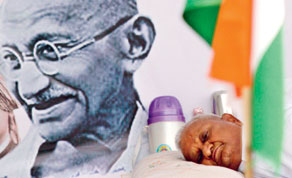
Veteran social activist Anna Hazare sleeps next to a huge poster of Mahatma Gandhi and the Indian flag on the second day of his hunger strike in New Delhi yesterday
The government, however, tried to cool the situation by saying it was not averse to civil society’s suggestions.
On the second day of Hazare’s hunger strike at Jantar Mantar, a short distance from Parliament House, thousands came forward in support of his crusade, making it one of the most supported mass movements in recent times.
According to India Against Corruption, the banner under which the protests are being held, people from 400 cities and towns are participating in the movement.
“This is democracy and we want people’s participation in drafting the Lokpal Bill,” Hazare told reporters.
“We want representation from civil society in drafting the Lokpal Bill, 50% from civil society and 50% from the government,” he said. The bill aims to fight corruption in public life.
Hazare, 72, said his health was fine.
“The doctor came; he said BP (blood pressure) is fine, I only have a little weakness,” Hazare said, adding in jest: “I will only lose some weight, can carry it forward for 10 or 12 more days.”
Members from the Group of Ministers (GoM) formed for the Lokpal Bill tried to extend an olive branch, saying the government was not averse to the suggestions from civil society.
“The government is certainly not opposed to any of the suggestions that have been raised except that when the suggestions were being raised the sub-group was asked to commit that in principle we must agree to a joint committee and this must be done before the 5th of April,” said Telecom and Human Resource Development Minister Kapil Sibal, who is a member of the GoM’s drafting sub-committee.
The sub-committee is headed by Defence Minister A K Antony. Besides Sibal, its members are Agriculture Minister Sharad Pawar and Law Minister M Veerappa Moily.
Moily said the government “did not say no” to the demand for a joint committee to draft the bill after the sub-committee held discussions with representatives of Hazare and other members of civil society.
“Even on the demand for a joint committee, we said we were open. We never closed our mind even on the formation of joint committee...In principle we did not say no,” Moily said.
The activists had questioned the credibility of the members, including Sibal, Pawar and Moily, for drafting the bill and blamed them for not being sincere.