


 |
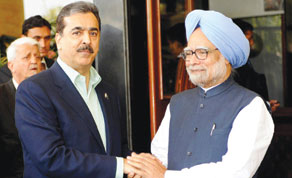
| Prime Ministers Manmohan Singh greets Yousuf Raza Gilani before the ICC Cricket World Cup 2011 semi-final between India and Pakistan at the Punjab Cricket Association (PCA) Stadium in Mohali yesterday |
The prime ministers of India and Pakistan stood side by side yesterday at a World Cup cricket match and clapped to each other’s national anthems in a symbolic gesture aimed at rebuilding ties shattered by the 2008 Mumbai attacks.
Minister Manmohan Singh Yousuf Raza Gilani shook hands with the two teams in the northern town of Mohali at a semi-final match between the South Asian neighbours that have gone to war three times since.
Such is the fervour surrounding cricket in the two countries that scores of Pakistanis crossed one of the world’s most militarised borders to travel to the stadium while millions of Indians took the day off work to watch the game.
“Enjoy Cricket, It’s Not War!” was the front page splash of India’s Mail Today newspaper.
Singh had invited Gilani to watch the game and discuss reviving a peace process, although “cricket diplomacy” will offer more gestures than breakthroughs in a conflict that has lasted for more than 60 years.
“Keeping in view the sentiments of people of both countries, I’m going there to express solidarity with our team as well as their (Indian) team and to promote cricket,” Gilani told reporters before flying to India.
Attacks in Mumbai in 2008 heightened distrust between the two countries that have fought over Jammu and Kashmir for decades, a conflict heightened by a host of other issues from border skirmishes and to conflicts over water supplies.
New Delhi blames Pakistani militants in collusion with elements of the government, including Pakistan’s spy agency, for the Mumbai assault.
But concerned about his legacy, the 78-year-old Singh has pushed reconciliation with Pakistan despite misgivings within his own government.
In a major confidence-building measure ahead of the match, Islamabad agreed on Tuesday to let Indian investigators travel to Pakistan to probe the Mumbai attacks after a meeting of the countries’ respective home secretaries.
“As far as our relations are concerned, I’m happy our talks have resumed and interior (home) secretaries’ talks were held in a positive manner,” Gilani said.
“Dr Manmohan Singh is very good politician. His approach is very positive and he wants to do something for peace and prosperity of this region so we both are committed that the environment should improve and we could serve people.”
The two cricket-crazy nations have talked of little else for the past week in a buildup that has put the spotlight on, among other topics, players’ preparedness, a row over match-fixing, and public prayers for victory.
Cricket is just one of the many cultural, religious and ethnic ties the two countries share dating back thousands of years despite decades of mistrust.
Army helicopters and anti-aircraft guns have imposed a no-fly zone over the Mohali stadium, a few hours’ drive east of the Pakistani border, to prevent an attack by militants.
Thousands of fans, many draped in the Indian tri-colour, lined up outside the stadium gates more than seven hours before the start, blowing mini vuvuzelas and whistles.
Scores of Pakistani fans crossed the border post in India’s northern Punjab state on Tuesday amid tight security.
“I tell everybody: ‘you should not fight at the border, rather the battles should be fought on the cricket grounds.’ That’s what people from both countries love to see,” Mohamed Bashir Khan, a Pakistani supporter from Chicago, said after flying into India for the showpiece event.
Many companies in both countries declared yesterday as a half day. The Karachi stock exchange plans to put a big screen up for traders to watch. Lawmakers in the eastern Indian state of Bihar petitioned their government to suspend legislative business during match time.
“This is a more important event than any other event for Pakistan this year,” said Omar Ehtisham Anwar, a fund manager at Faysal Asset Management in Karachi who took the day off to watch the match.
“There is no way I would miss even a second of this match - I will try to not even blink during the game.”
For Prime Minister Singh, the match may be a way of regaining the policy initiative after his government has been battered by months of corruption scandals that could dent the ruling Congress Party’s chances in upcoming state elections.
Both sides will hope to ride a wave of goodwill ahead of talks between their foreign ministers in July, but some were sceptical about “cricket diplomacy,” which was tried as long ago as far back as 1987, without bringing lasting peace.
“It facilitates resolution, it doesn’t lead to resolution,” former Pakistani president Pervez Musharraf told the Indian news channel Times Now. “Cricket diplomacy doesn’t mean that you can resolve disputes just because you attended a match together.”