


Agencies/New Delhi
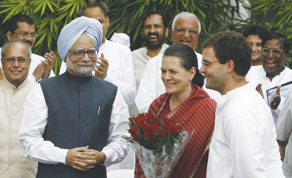
In this photograph taken on July 23, 2008, Congress Party president Sonia Gandhi chats with Prime Minister Manmohan Singh as her son Rahul Gandhi looks on at her residence a day after the Congress-led government won a parliamentary confidence vote. Leaked diplomatic cables revealed yesterday a US diplomat in New Delhi was shown “two chests containing cash” by an aide to senior Congress politician Satish Sharma, and was also told they had a fund of Rs500-600mn ($11-13mn) to pay off lawmakers to ensure the government would survive the vote
Opposition parties forced parliament to adjourn yesterday and demanded Prime Minister Manmohan Singh resign over a WikiLeaks report that his party paid bribes to win a confidence vote in 2008, a fresh blow to the scandal-tainted coalition.

The Hindu newspaper, citing US diplomatic cables released by WikiLeaks, said a ruling Congress Party official told a US diplomat they had a fund of Rs500-600mn ($11-13mn) to pay off lawmakers in 2008.
The WikiLeaks report said Nachiketa Kapur, an aide to prominent Congress figure Satish Sharma, had showed the diplomat two chests of cash and said four lawmakers of the regional Rashtriya Lok Dal party had been paid Rs100mn ($2.2mn) each to secure their support.
Sharma, a close associate of Congress Party chief Sonia Gandhi, told television news channels yesterday he did not have an aide called Nachiketa Kapur.
Analysts said the report was unlikely to affect the stability of the government, given the charges were old and that the new revelations could be written off as the personal perception of a diplomat that could not hold in a court of law.
But it added to the woes of a government already under fire for a slew of corruption cases, including a telecoms scam estimated to have cost the state billions of dollars.
“It is embarrassing for the government, but it is not that serious. Nobody is going to vote against the government on this,” said D H Pai Panandikar, head of New Delhi-based think tank RPG Foundation.
The WikiLeaks report seemed to back earlier charges by the main opposition Bharatiya Janata Party (BJP) that the vote was bought, and adds pressure to Singh, reeling from the corruption charges against his administration.
BJP leader Sushma Swaraj said Singh’s government had lost its legitimacy.
“This government has been under attack for the last three months, but this is a hammer blow that it cannot recover from,” Swaraj said in the Lok Sabha, the lower house of parliament. “It has lost all moral responsibility to govern.”
Lok Sabha Speaker Meira Kumar was forced to suspend proceedings for the day after BJP lawmakers noisily demanded Singh resign.
The WikiLeaks report adds to a long list of scandals, led by charges former telecom minister A Raja took bribes to dole out lucrative phone licences at rock bottom prices. That cost the state coffers as much as $40bn in lost revenue, the government auditor has estimated.
Political protests over the scandals have led to economic reforms, such as opening up the supermarket sector for foreign investors and the deregulation of diesel prices, being put on the backburner.
“(The aide) mentioned money was not an issue at all, but the crucial thing was to ensure that those who took the money would vote for the government,” the newspapers quoted from the cable.
Another Congress leader told the diplomat “PM Singh and others” had tried to get a businessman to persuade a regional official to support the government, but had failed, the newspaper reported.
Finance Minister Pranab Mukherjee said the government could not confirm or deny the report.
“There is a diplomatic immunity to what a sovereign nation discusses with its mission abroad, no access can be made to them, the government cannot confirm or deny it,” Mukherjee said.
“Every Lok Sabha is sovereign in its period; whatever happened in the 14th Lok Sabha cannot be dragged in 15th Lok Sabha. The 14th Lok Sabha has been dissolved.”
Mukherjee also said the revelations were not admissible evidence in any court of law.
But BJP leader and lawyer Arun Jaitley disagreed: “Diplomatic immunity may be available to US diplomats, it can certainly not be claimed by the government of India for a crime committed by Indians in India.”
Former SP leader Amar Singh, accused of being the middleman in the scandal, said he didn’t see substance in the allegations.
“First of all, (RLD leader) Ajit Singh had got only three MPs and not four MPs; the rate formulated at that time by comrade A B Barshan was Rs20 crore (Rs200mn) each and not Rs10 crore,” Singh said.
“And even if it is assumed that Rs10 crore was paid, the fact of the entire matter is that Ajit Singh’s MPs voted against the government. And the claim of Mulayam Singh on the floor of the house that the Samajwadi Party played a leading role in saving the government is absolutely a bundle of falsehood,” he added.
Ajit Singh denied that his MPs were bought off and his party in fact voted against the government.
“Our party was against the nuclear deal. After extensive discussions with parties, we decided to vote against the government and we did vote against the government,” Singh said.
Ahead of the vote in 2008, BJP lawmakers had brandished in parliament wads of currency notes they claimed Congress officials had given them to support the government.
The government narrowly won the vote, which was forced on it after Communists pulled their support due to a landmark civil nuclear co-operation deal between the US and India.
Singh has been attacked by the opposition for appearing to pander to US interests, and staked his political career on the landmark nuclear deal.
The report appears to have some inconsistencies. The four lawmakers whom the Hindu report said were paid bribes by the Congress official actually voted against the government. A committee set up to probe the charges in 2008 gave an inconclusive report.