


Agencies/
 The Supreme Court yesterday rejected an appeal for euthanasia on behalf of a woman who has been in a vegetative state for 37 years, officials said.
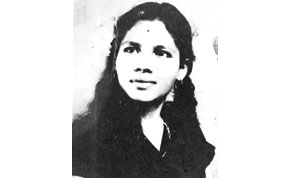
Aruna Shanbaug (PICTURED), 60, once a nurse at Mumbai’s
Justices Markandey Katju and Gyan Sudha Misra said the facts and circumstances of the case, medical evidence and other material suggested that Shanbaug “need not be subjected to euthanasia.”
The court said euthanasia was illegal in
Active euthanasia is putting an end to a person’s life, for example, by administering a lethal injection, while passive euthanasia involves withdrawing life-support systems from a patient. Shanbaug is not on a life support system.
“The court has allowed passive euthanasia in some persistently vegetative or terminally-ill patients and laid certain conditions in this regard,” Shubhangi Tuli, the lawyer who argued Shanbaug’s case, told reporters outside the court.
“We will get to know these conditions only after reading the judgment in detail,” she said.
Pinki Virani, a journalist who has written a book about Shanbaug, had filed a petition in Supreme Court in 2009, saying the former nurse was “virtually a dead person.”
Shanbaug’s assailant used a dog chain to tie her to a hospital bed and in the process damaged her nerves and her brain. The attacker was later sentenced to seven years in jail for attempting to murder her.
In the plea, Virani asked that the hospital be instructed to stop force-feeding Shanbaug as she was brain dead and could not see, hear or communicate.
When the court asked the hospital about her condition, physicians said Shaunbag accepted food and responded to commands with facial expressions and made sounds when she wanted to use the toilet.
The court said though Virani was performing a laudable social service, the staff, doctors and nurses of the KEM hospital have a greater right over her and only they can decide whether to opt for passive euthanasia or not.
Lawyer T R Andhyarujina, who was an adviser to the Supreme Court in the case, said it was the first time there had been a ruling on euthanasia by the top court.
“The court has accepted the withdrawal of a life support system, but has not given the permission to inject any lethal substance,” he explained.
Reacting to the ruling, federal Law Minister M Veerappa Moily said the issue of euthanasia needed to be seriously debated.
“There is no question of concurring or not with the judgment. But in fact, they (Supreme Court) are right that without a law you cannot resort to this kind of a decision with a judicial order,” Moily said.
Indian laws do not permit euthanasia or self-starvation to the point of death, although fasting is a part of Indian culture, made famous by Mahatma Gandhi.
Gandhi vowed to go on hunger strikes until death several times in protest against British rule.
The only exception to the law on self-starvation is the religious practice of “santhara,” which sees elderly believers from the Jain religion give up food and water until death.
The custom of santhara is currently under judicial scrutiny after human rights activist Nikhil Soni approached the Rajasthan High Court in 2006 calling for a ban on the 2000-year-old practice.
Laws on euthanasia or assisted suicide, in which patients are helped by doctors to end their own lives, vary across the world.
In
In 1994, the
The state of