


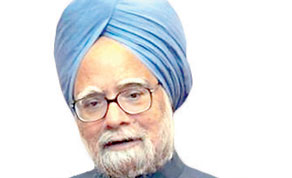
Agencies/
 Prime Minister Manmohan Singh yesterday vowed to stay in office to press ahead with reforms, denying a series of massive corruption scandals had made him a lame duck leader.
Allegations the government may have lost up to $40 in revenue after companies were awarded telecoms deals at rock-bottom prices in return for kickbacks have caused months of parliamentary paralysis, rocked the ruling coalition and rattled
“Whatever some people may say, that we are a lame duck government, that I am a lame duck prime minister, we take our job very seriously,” an often frail-looking Singh, 78, said in a rare media roundtable with TV editors to improve his worsening image.
“We are here to govern, and to govern effectively. Tackle the problems as they arise and get this country moving forward.”
The Congress Party-led government is currently not at risk of collapsing due to the support it has from coalition allies.
But that Singh was forced to deny talk of resignation underscored both the gravity of the scandals and how his decision-making has been paralysed in his second term despite being re-elected in 2009 with an increased majority.
The last parliamentary session was halted by opposition protests demanding a cross-party probe into the telecoms scam, effectively stopping any reform bills such as one to make land acquisition easier for both industry and farmers.
Some analysts said investors would be heartened by such a probe, which the government had initially resisted but now appeared to be willing to allow, mainly to ensure the next parliamentary session, due to discuss the budget, would not be disrupted.
“Today is not enough. It needs to be followed up with several more steps. Hopefully the next one will be a JPC (a joint parliamentary probe),” said Andrew Holland, CEO of Equities at Ambit Capital in Mumbai.
“Companies outside
Yesterday, Anil Ambani, one of
“Things are not entirely the way I would like them to be but quite frankly I never felt like resigning because I have a job to do,” Singh said in comments broadcast live.
He also said he never claimed he had never made a mistake but added he was not “such a big culprit.”
“I do not say that I have never made a mistake. But the kind of propaganda being done and shown, I am not such a big culprit,” the prime minister said.
“I, through your medium, am promising the people of
Singh offered no new proposals on cracking down on corruption, which has long plagued all walks of life in
Nitin Gadkari, president of the main opposition Bharatiya Janata Party (BJP), said Singh’s statements were a “cover-up”.
Indian stocks, Sensex, are down nearly 11% this year, the worst performers among major Asian markets, with worries about corruption scandals keeping investors on edge.
Foreign investors have pulled hundreds of millions of dollars from the Indian stock market since the start of the year, while foreign direct investment (FDI) has fallen for three consecutive years, from 2.9% of GDP in 2008/09 to around 1.8% of GDP in 2010/11.
Some of this is connected with the global economic slowdown, but regulatory uncertainty may also be a factor.
“This sort of atmosphere is not good. It saps our own self-confidence. It also spoils the image of
For more than an hour, editors peppered Singh with questions about why he had failed to act on graft cases, allegedly corrupt ministers and why probes had taken so long.
Each time, Singh, looking defensive and rattled, denied wrongdoing, often referring to a prepared written statement. Sometimes he blamed coalition politics for the lack of quick decisions, other times, the media.
Singh’s stumbling has prompted some commentators to predict a repeat of 1989, when Congress lost a general election due to the Bofors scandal. That centred on gun contracts involving close associates of then prime minister Rajiv Gandhi who were accused of taking bribes.
The next general election is still three years away and Singh has opportunities to regain the initiative, whether through spending on social welfare programmes or doing better than expected in state elections this year.
But Singh has always been hampered by the image of playing second fiddle to Congress Party head Sonia Gandhi, and, as a figurehead leader, exercising little real power.
In yesterday’s broadcast, Singh’s most uncomfortable moment came when he was asked why he had reappointed former telecom minister A Raja to his cabinet despite complaints about the fraud-tainted mobile phone licence sales in 2008.
Raja was arrested earlier this month and remains in police custody as investigators probe what could be
Raja, Singh pointed out, was from a regional party included in his coalition government and was that party’s preferred candidate for the cabinet berth.
“I had not reason to feel anything seriously wrong had been done,” he said.
“Although complaints were coming in, although complaints were coming from all sides, some from companies not benefiting (from the telecoms spectrum allocation) ... I was not in a position to make up my mind that anything seriously was wrong,” Singh said.
Singh’s government now appears close to agreeing to a broad, JPC probe into the scandal, paving the way for parliament to resume as normal for a February 21 budget session, and Singh said he would press ahead with some reforms.
“We have not given up, we will persist (on reforms). There are difficulties, particularly when government is not allowed to function,” he said.
In one sign the prime minister may attempt to refresh the image of his government, Singh said there would be another cabinet reshuffle after the budget session. The first reshuffle in January was widely criticised as cosmetic.
“We have important legislation, apart from the budget, to put before parliament,” Singh said. “And talks are going on with the opposition parties to ensure that whatever our differences, parliament should be able to function normally.”
The scandals have taken a heavy toll on Singh, who is concerned his legacy is shifting from that of a founder of India’s economic boom, to someone who did nothing to stop corruption or policy paralysis.
Singh may have hoped the current scandals would ebb. But an aggressive media, an assertive Supreme Court and an opposition tasting political blood have seen momentum into the corruption probes expand.
A vendor sells vegetables on a street in New Delhi yesterday. Under attack for high food prices and slow reforms, Prime Minister Manmohan Singh said his government has not given up its economic agenda and promised clear measures in the upcoming budget. Food inflation has been hovering above 15% in the past few months before falling to 13.07% in the last week of January.