


Agencies/New Delhi
Federal investigators yesterday said they have arrested the head of one of the country’s leading real estate firms in a probe into an alleged multi-billion dollar telecoms fraud.

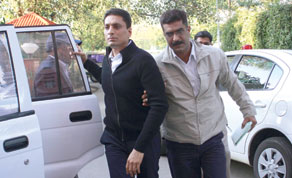
Central Bureau of Investigation (CBI) officials escort Shahid Balwa (centre, in black) at the agency’s headquarters in New Delhi yesterday after he was arrested
A spokeswoman for the Central Bureau of Investigation (CBI) in New Delhi said Shahid Balwa, the managing director of DB Realty, was detained at his home in a Mumbai suburb late on Tuesday night.
“He will be held in transit remand for two days and will be brought to Delhi,” she said.
His arrest is part of an investigation into the sale of second-generation (2G) mobile phone licences for knock-down rates in 2008, which is estimated to have cost the Indian exchequer up to $40bn.
Balwa is also the vice-chairman of Etisalat DB Telecom India Ltd, a joint venture between DB Realty’s parent company Dynamix Balwas (DB) Group and the Abu Dhabi-based telecoms giant Etisalat.
It was the first arrest of a company executive in the scandal that has rocked the Congress Party-led government and undermined Prime Minister Manmohan Singh.
The scandal, one of several during the Congress Party’s second term, has not yet threatened the survival of the coalition because it holds enough seats in parliament, and Singh is still seen as one of the few politicians skilled enough to hold the government together.
But it has already led to the arrest of former telecoms minister A Raja and the opposition, led by the Bharatiya Janata Party, is going after the prime minister, accusing him of allowing graft to go unchallenged.
With the government and Singh on the back foot, the risk is that the scandal could hurt the coalition in state elections this year and prompt the government to shift to more populist measures, putting economic reforms in jeopardy such as allowing foreign investment in multi-brand retail and financial sectors.
Ultimately, it could weaken the unity of the coalition ahead of the 2014 general election.
“It is inevitable that as these scandals continue to arise, the spotless kurta of the clean man will begin to look dappled,” said M J Akbar, editor of news magazine India Today, referring to the prime minister’s traditional white tunic.
Former minister Raja, who is under questioning, is suspected of rigging the rules to favour certain companies, allegedly including Etisalat DB - when it was called Swan Telecom.
Etisalat DB holds telephony, Internet and broadband licences in 15 areas across India covering 900mn people, the Mumbai-based firm said on its website.
Police suspect government officials colluded with the private sector in selling them lucrative 2G mobile licences below market value and are now probing whether anyone received kickbacks.
The case is India’s biggest graft scandal since 1989, when the Congress Party lost a general election due to the Bofors scandal over gun contracts involving close associates of then prime minister Rajiv Gandhi, who were accused of taking bribes.
“The same story of Rajiv Gandhi’s election loss after Bofors is in danger of being repeated,” said Paranjoy Guha Thakurta, a political analyst in New Delhi.
India’s mobile market is huge with around 730mn subscribers, roughly equivalent to Europe’s population. The number of subscribers is growing at some 17-18mn a month.
In another controversy this week, federal auditors are probing the allocation of satellite communication bandwidth to a firm by the Indian Space Research Organisation, a portfolio overseen by the prime minister. The government has moved to cancel what it says was a flawed 2005 contract that undervalued the spectrum.
Opposition claims that potential income of $44.1bn could have been lost may fail to gather momentum due to the case’s complexity and the fact the satellites have not even been launched. But once again, Singh has been accused by the opposition of negligence.
The government has denied the opposition’s claims.
“These decisions have been taken by technocrats, possibly without commercial savvy,” said Mahesh Uppal, director of telecoms consulting firm Com First. “The government may have erred in its process.”
Parliament’s last session was halted by opposition protests demanding a probe into the 2G scandal.
The government has refused a parliamentary investigation, but there have been recent signs it may cave in, worried more chaos could make the passage of the key February 28 budget difficult.
A statement from DB Realty yesterday said that Balwa had been “wrongly implicated” in the alleged scam.
“We reiterate that neither Mr Balwa nor any person/entity forming part of the DB Group has done anything inappropriate or illegal,” the company said.
“Mr Balwa will be strongly contesting the proceedings. He has immense faith in our judiciary and judicial system and is confident that ultimately the truth will prevail and Mr. Balwa will stand vindicated.”
DB Realty, which had a net worth of Rs32.1bn at the end of December last year, said the developments will not affect the functioning of the company “in any manner whatsoever.”