


Reuters/Kolkata
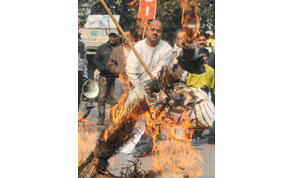
Activists of the Socialist Unity Centre of India (SUCI) shout slogans as they burn an effigy of Prime Minister Manmohan Singh to protest against the price hike of petrol in Siliguri, West Bengal yesterday
Thousands of supporters of Trinamul Congress, a key party in the ruling United Progressive Alliance coalition, marched through the eastern city of Kolkata yesterday to denounce double-digit food inflation, the latest sign of unease among the government’s partners before critical state elections.

“We will not accept skyrocketing prices,” read a giant banner at the 4,000-strong rally organised by the Trinamul, whose support Prime Minister Manmohan Singh depends on for a majority in parliament.
Trinamul has its power base in West Bengal state whose capital is Kolkata.
The party has pledged to stage a rally in New Delhi tomorrow against a 4.5% rise in petrol prices imposed by state-run oil firms, the second increase in about a month.
India battled double-digit inflation through most of 2010, the highest rate of any major Asian economy. Spiralling food and fuel prices have damaged voter confidence in the government led by the Congress Party and highlighted stresses in the multi-party coalition.
Some of Prime Minister Manmohan Singh’s allies, such as the Trinamul Congress and the Dravida Munnetra Kazhagam party, which underpin the coalition’s majority in parliament, face a tough fight in local elections due by May.
High prices could affect the Congress Party’s prospects in state elections, and if its allies fare poorly as well it would put the coalition under strain.
Trinamul is not expected to abandon the Congress-led UPA, but is trying to distance itself from price increases ahead of the West Bengal vote, in which it hopes to dislodge the communist government, in power for three decades.
“We are concerned and we demand that we should be consulted while taking steps like increasing petrol prices,” Trinamul leader Sudip Bandopadhyay said. “High price is a burning issue and we cannot let the poor be hurt like this.”
The party holds 19 seats and is a key constituent of the UPA which has a majority of just 16 in the 545-member parliament.
A recent poll showed voter discontent with Congress Party would result in a loss of 40 seats in a general election, threatening its majority and damaging its ability to form a working coalition government.
Governments around the world have been taking steps to tackle soaring grain prices and head off unrest, with north African countries Libya, Algeria and Morocco cutting taxes on foods or regulating prices and stepping up supplies.
India’s headline inflation stood at an annual 8.43% in December, following a 7.48% rise in November, as food inflation hit a year-high this month before easing marginally to 16.91% last week. This has kept up pressure on the central bank to raise rates this month.
Even the Congress Party expressed worry over high inflation, seeking to put the onus of petrol price hikes on the oil firms.
“I couldn’t agree with you more that inflation is a cause of concern. A Rs5 per litre hike does seem to be a tad unfair,” said Manish Tewari, Congress spokesman.
High prices top of the list of headaches for Singh’s government, which is also mired in corruption cases that have emboldened the opposition.
The DMK also said yesterday it feared being punished by voters in elections in the southern Tamil Nadu state over high food prices.
“Definitely we are concerned, and whichever government is in power will be held responsible. That is why we have expressed our concerns to the (federal) government,” said DMK spokesman T K S Elangovan.
Elections are also due over the course of the year in Kerala in the south and Assam in the northeast.
Singh is considering reshuffling his cabinet, possibly as early as tomorrow. The prime minister needs to fill several vacancies, some which occurred as a result of the departure of ministers over graft accusations.
He could make cosmetic changes or remove controversial ministers, such as Environment Minister Jairam Ramesh whose promotion of green laws has triggered a row with industry.
The reshuffle could show the direction the government will take, either to back reformist ministers or bow to political expediency and industry pressures, in the run-up to important state elections this year and a general election due by 2014.