


 |
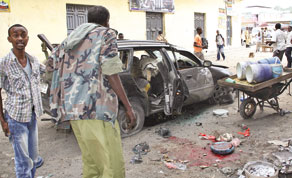
| A Somali officer tries to secure the scene of an explosion at Hamarweyne district of Mogadishu yesterday |
The leaked report said key leaders at the very top of government - including the president and the speaker of parliament – are mired in scandal, boosting the cause of Al-Qaeda-linked Shebaab insurgents. It called for the UN Security Council to impose sanctions “with the least possible delay”.
Somalia’s Western-funded Transitional Federal Government (TFG) ends its mandate next month, with several members hoping to remain in power afterwards. Many are accused in the report of “pervasive corruption”.
President Sharif Sheikh Ahmed and parliament speaker Sharif Hassan are among leaders named in allegedly corrupt deals, the report by the UN Monitoring Group on Somalia and Eritrea said. “Out of every $10 received by the TFG in 2009-2010, $7 never made it into state coffers,” said the report, a copy of which was seen by AFP.
In 2011, almost a quarter of total government expenditure - over $12mn - was “absorbed” by the offices of the president, prime minister and speaker, it said. This equalled half the TFG’s domestic income and “almost as much as the government spends on security in a time of conflict,” it added.
A May 2012 World Bank report found $131mn unaccounted for in TFG revenues in 2009-2010, or 68% of total recorded revenues, but the UN report suggested a further $40mn in 2011 could be missing.
“Many TFG officials make no distinction between public and private finances, and treat financial rules and institutions as obstacles to be circumvented or disregarded,” it said.
While the Shebaab have suffered a string of territorial losses in recent months, helping the government consolidate its fragile hold over the conflict-torn country, rampant corruption endangers what little gains have been made, the report said.
“The systematic misappropriation, embezzlement and outright theft of public resources have essentially become a system of governance,” it said, warning corruption was “the most serious impediment to building effective governing institutions”.
A failure to address the issue threatens “the restoration of peace, security and stability”, and “would fuel continued instability and conflict, potentially reviving the fortunes of an embattled Shebaab”, it said.
The report “therefore recommends that the Security Council... consider imposing targeted measures, and possibly other forms of political censure, against the senior Somali political leaders who bear responsibility.”
It also warns that the Shebaab remains a “serious threat to peace, security and stability, not only in Somalia but also on the broader international scene,” despite losses and leadership rifts.
The Shebaab is “actively strengthening its ties with other foreign extremist groups” including Kenya’s Muslim Youth Centre (MYC) and Tanzania’s Ansaar Muslim Youth Centre (AMYC).
It warns that Kenya’s MYC “seeks to use its sanctuaries in Somalia as springboards for terrorist acts in Kenya, deploying several operational cells to Kenya in recent months for this purpose.” Kenya has seen a spate of attacks in recent months.
Al Qaeda’s endorsement of the Shebaab may also boost relationships with groups including Yemen’s Al Qaeda in the Arabian Peninsula and Boko Haram in Nigeria, “both of which have engaged with Shebaab in the recent past.”
The report details a catalogue of examples of corruption in Somalia. In one, officials ordered a mass printing of banknotes worth $130-$150mn, in a deal negotiated by the speaker.
Described as “little better than counterfeiting” the report said the deal was to “generate a political slush fund, enable large scale corruption and finance the ambitions of certain TFG leaders to interfere with the political process.” Much of the funding from foreign aid “never reaches the Central Bank or the Treasury,” it adds.
President Sharif told UN investigators the cash was “perhaps in the pockets” of others, before “calling for more aid” because the government was struggling to pay workers their wages.
Sharif was also fingered in the failure of Somalia’s new passport authority - also allegedly missing $1.5mn in revenue - where fraud and corruption are rampant, posing “potential threats to regional and international security.”
At least one senior Shebaab leader has been issued a passport, while one of Somalia’s “most notorious pirate leaders received a diplomatic passport,” the report added.
The president told the group that pirate kingpin Mohamed Abdi Hassan ‘Afweyne’ was given the passport as an inducement to end his criminal network.
The report also points to worrying “large scale misappropriation or diversion of lifesaving assistance” in Somalia, which is still reeling from extreme drought and famine conditions last year.
Somali lawmaker assassinated
A car bomb killed a Somali lawmaker allied to the president, an official said yesterday, in an attack claimed by the Shebaab militant group that is fighting the Western-backed government.
“The MP himself was driving the car. A bomb had been placed in his car without his awareness,” deputy Mogadishu Mayor Warsame Mohamed told Reuters.
“The MP died. His flesh and documents are in the car,” said Mohamed, referring to Mohamud Abdi Ibrahim, who was also a former minister for humanitarian affairs and trade.
Shebaab claimed the attack shortly afterwards. “We targeted the MP and killed him with an assassination bomb,” Sheikh Abdiasis Abu Musab, spokesman for Shebaab’s military operations, said. “We managed to place a bomb in his car. Government officials and those who work with them are infidels.”
Mohamud was known to be close to President Sheikh Sharif Ahmed. They belonged to the alliance that entered the government in 2009 through a power-sharing deal in Djibouti.