


 |
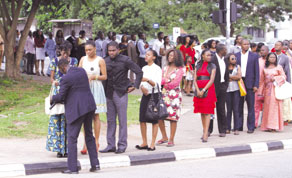
| Worshippers are screened by a security guard before being allowed into church premises in Nigeria’s capital Abuja |
“There was an attack on the Yobe prison this morning, the Boko Haram sect attacked the prison through the Emir palace, 40 inmates escaped,” said Patrick Egbuniwe, Yobe State police commissioner.
“They attacked with rifles, the police and the joint task force confronted them and the Boko Haram members that were shot were carried away by the sect.”
He said two of the attackers were shot dead and some policemen were injured. Gun battles between sect members and security forces in Yobe’s capital Damaturu killed 40 people on Tuesday last week.
Boko Haram has been blamed for several prison breaks in the past and one of the group’s few demands has been that its imprisoned members should be freed.
The sect, which is based in the remote northeast, has rapidly overtaken militants in the oil-producing southern Niger Delta as the country’s biggest security threat.
Months of gun and bomb attacks blamed on Boko Haram have killed hundreds since the movement started its uprising more than two years ago.
It is fighting to carve out an Islamic state in Nigeria - a country nearly evenly split between Muslims and Christians. Attacks on churches have intensified this month, sparking deadly religious violence in northern Kaduna state.
Some churches in northern Nigeria, usually packed with worshippers, were almost empty yesterday morning and many people stayed away in other parts of the country after a week of violence in religiously-mixed Kaduna state.
Anthonia Eke is trusting God to end an Islamist insurgency in northern Nigeria but won’t be praying in church any more, after a string of bombs at Sunday services.
At least 92 people were killed in the tit-for-tat attacks between Muslims and Christians in Kaduna last week, sparked by suicide bombings at three churches last Sunday that killed 19 people and were blamed on Boko Haram.
“We are still traumatised over the attacks and have no intention to attend church service until total peace and normalcy are restored,” Eke said in Kano, Nigeria’s second-largest city after Lagos.
“God understands our situation here so we have decided to pray at home. Only he can end this pain.”
There were fewer than usual at churches in the capital Abuja, which sits in the centre of the country where the largely Muslim north and mostly Christian south meet.
But hundreds still queued to pass through military checkpoints outside the largest churches in Abuja, and hundreds of thousands of worshippers around the country were determined to attend regardless of the risks.
“They will always tell you that they would prefer to die in the house of God than dying in nightclubs or dying in the streets,” said Franklin Okoye, president of a church society in Abuja.
Religion plays a key role for almost everyone in Africa’s most populous nation, where “Thank God” and “Inshallah” are as common greetings as “hello” or “how are you?”
The escalating violence has raised fears of wider sectarian conflict in Africa’s top oil producer, which is reeling from months of attacks on government buildings and churches by followers of Boko Haram.
Boko Haram admit responsibility for some of the attacks but deny others, and security sources and many Nigerians believe their name is used as a cover for other groups aiming to stoke religious tensions.
“There seems to be some political undertones because for some time now people have been attacking the churches perhaps with a view to getting a reaction from the Christendom so that there will be a war in the country,” said John Abuere, a parishioner in Abuja.
Similar violence in the past has usually failed to spark sustained conflict in a nation whose Muslims and Christians mostly co-exist peacefully, despite periodic flare-ups of sectarian violence since independence from Britain in 1960.
“We do not preach gospel of retaliation, we preach peace ... security is everybody’s concern whether you are in your house or you are in the market or in the church or you are in the Mosque,” said Father John Sixtus Okonkwo, priest at Holy Trinity Catholic Church in Abuja.
President Goodluck Jonathan, a Christian from the southern oil-producing region, has been criticised for not stemming the flow of violence in the north, a region his opponents say he is out of touch with.
Jonathan traveled to Brazil for a sustainability summit at the height of the violence in Kaduna last week, drawing anger from many Nigerians.
He sacked his defence minister and national security adviser on Friday, a move foreign diplomats said was long overdue.