


AFP/Athens
Greece’s new prime minister and finance minister will both miss a key EU summit this week for health reasons, as Athens bids to begin renegotiating the terms of an unpopular austerity-based bailout.

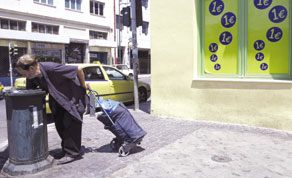
A man searches for food inside a garbage, in front of a One Euro shop in central Athens
Doctors told Prime Minister Antonis Samaras to avoid travel after undergoing major eye surgery, the government announced yesterday, meaning that Greece will be represented at the summit by Foreign Minister Dimitris Avramopoulos.
Finance Minister Vassilis Rapanos, who has yet to take his oath of office, is also in hospital after being admitted with stomach pains on Friday. Neither Samaras nor Rapanos are due to be discharged from hospital until at least Monday.
Experts from the “troika” of Greece’s creditors - the EU, IMF and the European Central Bank - have postponed an audit of the country’s finances that is deemed vital for the release of loan funds. The audit had been due to start today. “There is a delay, the exact date of the (auditors’) arrival will be set in the coming days,” said a government source.
Surgeon Panagiotis Theodosiadis said Samaras would take “days and weeks” to fully recover from a 3.5-hour operation on Saturday to repair 11 cracks found in his retina. He is expected to spend at least a week recuperating at home.
His coalition government that emerged from June 17 elections already has a mountain to climb, and no time to lose. State coffers are almost empty, with reserves set to last only until late July.
Structural reforms pledged in return for billions of euros in EU-IMF loans were suspended as the country held two elections in six weeks, with the first on May 6 failing to produce a workable government.
As a result, the troika of creditors lack a clear image of where the country stands, and no new funds can be released until this is clarified.
The exception is a 1bn euro instalment left over from before the elections, which is expected to be released by the end of June.
But it is too small a sum to make much difference to Greece’s debt.
Athens needs 7.6bn euros ($9.5bn) by the end of July just to cover maturing debt, and the state’s tax takings have fallen short of targets.
Greek banks are also in poor shape despite a recent recapitalisation to cushion the effects of a major sovereign debt rollover.
Greek newspaper To Vima yesterday said Athens breached the rules of its EU-IMF loan agreement by taking on some 70,000 public sector staff in two years, undermining efforts to reduce the state payroll.
The weekly added that a bill tabled in May to evaluate civil servants and axe nearly 2,000 ministry posts was never passed into law.
To Vima weekly said the hirings in 2010 and 2011 were highest in local administration, health, the police and culture, where the number of employees actually increased.
It cited a report from a permanent mission to Athens of the so-called ‘troika’ of international creditors, the EU, IMF and the European Central Bank, and data given by outgoing finance minister George Zannias.
An unidentified troika official told the daily: “While they legislated rules to reduce the number of civil servants, they were bringing people in through the window.”
The official added that over 12,000 people were hired by local councils even as a cost-cutting initiative merging municipalities was underway.
Zannias’ report to the new government coalition after June 17 elections allegedly reveals that although over 53,000 civil servants retired in 2010, the overall number of state staff was almost steady at 692,000 people, To Vima said. In this case, most of the vacancies were filled immediately, the daily said.
Similarly, although another 40,000 staff left in 2011, the net reduction on the payroll was only 24,000. By this time, Greece had promised to only hire one civil servant for every five that left. But over 16,000 people were hired instead of the allowed 8,000, To Vima said.
In his election campaign, Samaras had pledged to redress “injustices” in the austerity-centred bailout deal which most Greeks consider to have exacerbated the recession and killed off any demand left in the economy.
The new government, built around the conservatives and backed by socialists and moderate leftists, on Saturday said it wanted to freeze further civil service layoffs and bargain for a two-year extension to its tough fiscal adjustment.
The aim would be to meet fiscal goals “without further cuts to salaries, pensions and public investment” and new taxes, a government policy plan said.
There have been indications that a target extension can be considered, but eurozone hardliners such as Germany and Austria are unlikely to accept a watering-down of Greek commitments without a fight.
Austria’s finance minister yesterday said Greece’s demand for a two-year extension was “negotiable”.
But she noted that the reforms agreed must be completed.
“A reform path was agreed under which the Greeks would be able to finance themselves by 2020, without EU help. This substance of this target must be adhered to, and the agreed reforms done,” Maria Fekter told the Oesterreich newspaper.
“But it is negotiable whether this target could be pushed back from 2020 to 2022, so two years later. Our objective is also for Greece to have a booming economy again. The country cannot be killed by cuts,” Fekter said.
A Greek newspaper, Kathimerini, yesterday said creditors are unlikely to accept the new government’s request to reverse a minimum wage cut and recent labour reforms to facilitate layoffs. “The troika is displeased with the content of the three-party policy plan,” the daily said.
‘Reform retirement norm’
European Union President Herman Van Rompuy wants member states to look at changing the age of retirement to take into account longer life expectancy, Germany’s Welt am Sonntag reported yesterday.
“We can give recommendations to the Union as a whole, (saying) for example that there is a relation between the retirement and life expectancy,” he told the paper.
“We can commit all 27 member states to reforming their retirement systems within a fixed time and in a way that meets a fixed objective.”
It was important to not simply make recommendations and leave each country to do as it pleased, he said, stressing that limits had to be put in place. “It is one of the issues we have to discuss in the coming months...,” he added, saying that this would be one of the issues on the table at the two-day European summit, which starts Thursday in Brussels.
EU leaders will have the euorzone crisis at the top of the agenda at the Brussels summit.