


 |
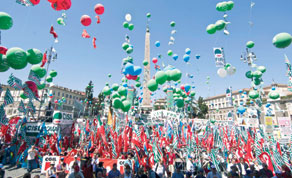
| Italian workers demonstrate in Rome against the government’s austerity measures in a protest organised by the three main Italian trade unions |
Italy is again flirting with economic disaster, Prime Minister Mario Monti warned as huge crowds massed in Rome in protest at his austerity measures a day ahead of an election in Greece that threatens to destabilise the whole eurozone.
“We stepped away from the precipice before, but the hole is growing bigger and it may swallow us up. We are again in a crisis,” Monti said yesterday at a ribbon-cutting ceremony near Milan.
Monti took over in November from discredited former prime minister Silvio Berlusconi and passed a tough austerity package to try to restore investor confidence as the recession-mired country teetered on the edge of a Greek-style default.
The measures, including 24bn euros in new taxes for this year alone, pushed down Rome’s borrowing costs for a time. But a banking bailout in Spain and prospects of Greece ditching the euro have seen the benchmark 10-year Italian bond yield peak above 6% again in recent days.
Yields pushing through 7% triggered international bailouts for Greece, Portugal and Ireland.
In the meantime, the austerity coupled with a labour market reform seen as threat to full-time workers have driven down Monti’s approval rating to 33% from 71% when he took office, pollsters SWG said on Friday.
Monti’s policies have been the focus of repeated criticism by the country’s three biggest labour unions, which staged a march yesterday and harangued the government during speeches in Rome’s People’s Square.
Organisers said that 200,000 turned out for the march through central Rome. They chanted, waved red and green-and-white striped flags, and blew whistles on a bright, hot morning in the capital.
“We are here because the government’s programme ... is causing the recession to deepen in our country,” Susanna Camusso, leader of Italy’s biggest labour union, told Reuters television.
She and other labour leaders urged the government not to cut the welfare system to reduce the deficit, and to focus instead on creating new jobs as unemployment climbs above 10%.
“The elections in Greece are obviously a major concern, but we need to remember that if Greece is in trouble it is because Europe from the start did not choose social policies as a way out of the crisis,” she said.
Camusso called for a “change to the political agenda, without which the country has no prospects”.
She slammed the “inequity and inequality” of Monti’s plan, saying it contained “no answers on employment and development”.
The Rome march passed off without incident, but a more vocal group is scheduled to march in Bologna later in the day despite a police veto.
Countering an increase in political as well as popular disenchantment with his government, Monti on Friday passed what he dubbed a “growth decree”.
The measures are meant to put emphasis on jump-starting the economy, which has been shrinking since last year.
Italy’s economy, the eurozone’s third biggest, grew on average less than any other EU country over the past decade.
Monti said the impact of the decree would take time to filter through.
Taking measures to stimulate growth was “is a long and difficult path. We will see some effects soon, but they cannot be measured in the next month or quarter”.
Italy is struggling with a public debt equal to around 120% of its gross domestic product, one of the highest levels in the 17-nation eurozone.
Figures released by the Bank of Italy on Thursday showed that it reached a new record high in April at 1.949tn euros compared with 1.946tn in March.