AFP/Canberra
Australia yesterday announced plans to create the world’s largest network of marine parks to protect ocean life, with limits placed on fishing and oil and gas exploration off the coast.

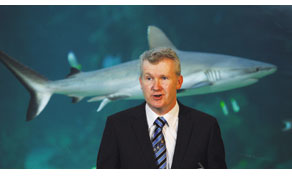
Australian Environment Minister Tony Burke announces plans to create the world’s largest network of marine parks to protect ocean life, during a press conference yesterday at the Sydney Aquarium
The new reserves would cover 3.1mn sq km, or more than one-third of Australian waters, taking in significant breeding and feeding grounds.
The announcement, after years of planning and consultation, came ahead of the Rio+20 summit on sustainable development next week in Brazil, which Environment Minister Tony Burke and Prime Minister Julia Gillard will attend.
“It’s time for the world to turn a corner on protection of our oceans,” Burke said in the lead-up to the meeting, which marks the 20th anniversary of the Earth Summit that declared the environment a priority.
“And Australia today is leading that next step. This new network of marine reserves will help ensure that Australia’s diverse marine environment, and the life it supports, remain healthy, productive and resilient for future generations.”
The network will increase the number of reserves from 27 to 60, expanding protection of creatures such as the blue whale, green turtle, critically endangered populations of grey nurse sharks, and dugongs.
While some limits will be placed on where energy companies can work, tracts of coast off Western Australia, where Shell and Woodside Petroleum recently won permits, will still be open to oil and gas exploration.
It follows warnings from Unesco that the heritage-listed Great Barrier Reef was at risk of being declared “in danger” due to an unprecedented resources boom which will see a massive increase in ship traffic and offshore industries.
The Australian Conservation Foundation welcomed the reserves initiative, calling it “a historic achievement”, but said it was concerned that some areas remained under threat.
“Although the reserve network bans oil and gas exploration in the Coral Sea, the northwest region has been left vulnerable to these threats,” said chief executive Don Henry.
The Wilderness Society called the announcement a first step, and said it was “clear that further marine sanctuaries will need to be put in place”.
“Our oceans are under constant pressure from trawling, overfishing, oil and gas developments and seabed mining,” said marine campaign manager Felicity Wishart.
But fishermen were up in arms, claiming coastal communities would be ruined, thousands of jobs lost and the A$2bn (US$2bn) aquaculture industry seriously impacted.
The Australian Marine Alliance, which has conducted a cost analysis, claims 60 regional communities would be affected, 36,000 jobs lost and 70-80 trawler operators displaced, while the cost of seafood imports will soar.
“This is devastating and those that will suffer most will be coastal communities,” said Dean Logan, head of the alliance that represents commercial and recreational fishers.
Burke disputed the impact on fisheries. “Reserves have been designed to minimise the impacts wherever possible. The reserves are estimated to displace approximately 1-2% of the annual value of wild catch fisheries production in Australia,” he said, adding that around A$100mn in compensation would be available to the fishing industry.
A final consultation period of 60 days is now scheduled with the new reserves expected to be officially declared before the end of the year.
Crocodile safari hunts under consideration
Australia is considering a plan to allow the trophy hunting of saltwater crocodiles, officials said yesterday, with the controversial idea being thrown open for public comment.
The federal government rejected a similar proposal several years ago on the ground that it was not appropriate, but has agreed to revisit the issue as croc numbers soar.
Environment Minister Tony Burke said he would not comment until the consultation process, open until July 25, takes its course.
“There are different views among different traditional (Aboriginal land) owners on this and I really want to make sure I get the opportunity to hear those different views,” he told reporters .
If approved, it would mean hunters could pay money to kill crocodiles, which the Northern Territory government says will provide jobs for Aborigines - with most crocodile habitat on their land - and stimulate tourism.
“We have been pushing the government to consider safari hunting for some time as a way to generate indigenous employment and I’m very pleased to see steps taken in this direction,” said Northern Territory Chief Minister Paul Henderson.
Under the plan, 50 saltwater crocodiles will be available for safari hunting for a two-year trial period, taken from the annual sustainable harvest quota of 500 adults already allocated under an existing management programme.
But not everyone is happy, with the Royal Society for the Prevention of Cruelty to Animals (RSPCA) saying it would take precision and skill to kill a crocodile humanely.
“There is no possible conservation benefit to be derived from the killing of crocodiles for trophies, nor does it provide a means of controlling problem crocodiles,” said RSPCA Australia chief scientist Bidda Jones.
“This is nothing more than killing animals for entertainment and there is no justification for that.”
Northern Territory environment minister Karl Hampton argued that safari hunting of feral animals such as buffalo and pig already existed on private land, and similar strict regulations would apply to crocodiles.
“Just like those safaris, the one proposed as part of our Crocodile Management plan is subject to the Animal Welfare Act and strict humane obligations will apply,” Hampton said.
Saltwater crocodiles, which can grow up to 7m long and weigh more than a tonne, are a common feature of Australia’s tropical north and kill an average of two people a year.
They have been protected since the 1970s with their population estimated at over 150,000.