By Pauline Askin, Reuters/Sydney
As light fades on the shores of Sydney Harbour, a group of men finish building a traditional aboriginal canoe using bark from eucalyptus trees. Smoke smothers the strips of bark as heat from a fire below curves the wood into the shape of a canoe.

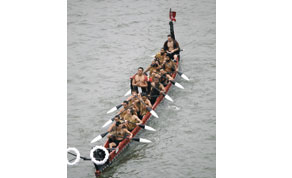
A Maori Waka (war canoe) approaches Tower Bridge during the Thames Diamond Jubilee Pageant in London on Sunday to celebrate Queen Elizabeth II’s 60 years on the throne
Just offshore massive container ships and multi-million dollar pleasure yachts anchor on the harbour, a world away from the days when Aborigines paddled bark canoes across the same body of water.
But now, Australia’s Aborigines are trying to revive the ancient skill of canoe building, known as Nawi, and pass the knowledge on to younger men in a bid to instil cultural pride.
“It’s a big part of their story. The canoe culture is something they’ve lost,” says David Payne, canoe builder and curator at the Australian Maritime Museum.
“When you look at the paintings that were done in the late 1700s, early 1800s as the harbour was being colonised, there were little canoes all over the place, and that just went very quickly.”
Under the Tribal Warrior Youth Mentor Group project, two canoes were built in one day at Blackwattle Bay on Sydney Harbour, part of the first Indigenous Canoe Cultural Conference held at Sydney’s Maritime Museum from May 30-June 1.
“We’re getting the elders and the younger people involved. It puts that knowledge back into the community,” Payne added.
Australia’s 460,000 Aborigines make up 2% of the 20mn population. They suffer higher rates of unemployment, substance abuse and domestic violence than other Australians, as well has having a 17-year gap in life expectancy.
In Kempsey on the mid-north coast, 420km from Sydney. a similar program is in place targeting young men between the ages of 12 to 18 years who are seen as being “at risk.”
The programme uses a reward system. The boys must attend school every day in order to be allowed spend one day a week at the agricultural station, building and learning the ancient tradition.
This has proven a success, with the boys more socially engaged, as well as having an overall sense of achievement.
“One of the measurable outcomes of a project like this is retention rates, so kids are going to school more often rather than wagging (skipping school),” said Alison Page, Program Manager at Saltwater Freshwater Arts Alliance, a regional body for Aboriginal arts, who attended the conference.
“But there’s a whole transformational change that happens within a person that is hard to measure,” she added.
The Kempsey project took months to build a dug out canoe, the first of its kind in that area in 50 years.
“It’s part of this whole cultural revival, this rebirth of traditional practices that the young people are just hungry for,” Page said.
“They’ve got a fire in their belly and they want to know about their traditional culture. I think we’re going to be seeing more and more projects like this, which is fantastic.”