


 |
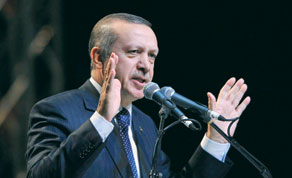
| Erdogan: Without living in Somalia you cannot devise the correct policies and you cannot help |
The UN should beef up its operation in Somalia, and other countries who want to help the war-torn state should actually move in and set up bases there, Turkish Prime Minister Recep Tayyip Erdogan said yesterday.
Erdogan’s direct remarks at an international conference on Somalia in Istanbul, the second hosted in Turkey in two years, was the latest sign of his administration’s growing interest and clout in Africa.
“Without living there you cannot devise the correct policies and you cannot help. I invite the international community to open representative offices,” Erdogan told the conference attended by UN Secretary-General Ban Ki-moon, the Somali interim president and delegations from more than 50 countries.
“We have really struggled to make Somalia’s voice heard, to make those who do not see or feel what’s going on in Somalia, see and feel,” he said.
Most aid agencies funding projects in Somalia are actually based in neighbouring Kenya or further afield.
Many moved their headquarters out of the country years ago to avoid kidnappings, looting and fighting between Al Qaeda allied militants and Somali troops backed by African forces.
Somalia has been mired in turmoil since the 1991 overthrow of dictator Mohamed Siad Barre.
Erdogan made a high-profile and whirlwind visit to the Somali capital in August last year, bringing his family and a plane full of ministers and consultants.
For all its brevity, the trip was still the first time a non-African leader had visited the country in almost 20 years.
While the visit was aimed at drawing attention to the famine that swept across the Horn of Africa nation, it was also part of Ankara’s wider strategy of positioning itself as a growing regional power and influential voice within the Muslim world.
Turkey has since opened an embassy in Mogadishu, built hospitals and schools and started direct flights between the two countries.
It has also sent hundreds of Somalis to study in Turkey.
While Turkey has been largely applauded for its assistance in Somalia, critics say that Ankara’s head-first policy and relative inexperience in the region leaves it vulnerable to manipulation by different political factions.
The Turkish leader also called on the UN to review its mission in Somalia and strengthen its presence there.
Speaking after the conference, UN chief Ban, who has visited Somalia since Erdogan’s trip, said his special representative had been based in Mogadishu since December and urged others to follow.
“We agreed on the need to insure that international assistance is predictable, transparent and co-ordinated. This can best be done when member states have a presence on the ground,” Ban told journalists.
He called for other countries to follow Turkey’s example by opening embassies in Somalia.
Ban also called for urgent international aid for Somalia to head off the risk of warlords exploiting a power vacuum after the scheduled change of power in August.
“We urgently need assistance to avoid a power vacuum that warlords might exploit,” Ban said. “I urge donors to contribute to this critical effort. In the face of terrorism, piracy and drought, Somalia needs solidarity.”
With the war-torn country’s transitional body preparing to hand over power in August, nations had to do their part to build a steady government after two decades of instability, the UN secretary-general said.
“The end of the transition marks the beginning of a new phase in the political process,” he added.
And the provisional consitution needed to be an inclusive one, he said. “All Somalis, regardless of gender, clan, or political affiliation should be able to take part in elections.”
It was important, he said, to gain the confidence of the Somali population, especially in areas recovered from Shebaab occupation.
The Istanbul meeting comes as government troops backed by an African Union force and anti-Islamist militia attempt to defeat the Shebaab, an insurgent group that has declared its allegiance to Al Qaeda.
Somali President Sharif Sheikh Ahmed spelt out the scale of the task that lay ahead for the Horn of Africa nation after two decades of conflict that has cost 400,000 lives since 1991.
The country’s infrastructure would have to be rebuilt, he said, adding: “It is a costly matter and our resources are very limited.”
Host country Turkey, which launched a major aid initiative last year for Somalia to help it through its worst drought in decades, also stressed the need for immediate help.
“Somalia needs, more than ever, material aid,” said Foreign Minister Ahmet Davutoglu.
The aim was to set up a new state structure following the August handover of power that would allow for normal life to return for good in Somalia, he added.
On the first day of the conference, Turkey’s Deputy Prime Minister Bekir Bozdag said the Somali capital Mogadishu was now open for business, as pro-government forces had largely driven out Islamist insurgents.
British Foreign Secretary William Hague, who was also attending the Istanbul conference, has underlined the improvement in the security situation in Mogadishu, saying three of his country’s ministers have visited this year.
But in a statement on Thursday he added: “All eyes are now on Somalia’s leaders to ensure that they deliver a peaceful handover of power and succession when the transitional period formally ends in August.”
The Istanbul conference builds on a February gathering in London.
The focus yesterday was on aid to Somalia after senior officials, experts and businessmen discussed the practical details of developing water, energy, roads and sustainability the previous day.
But lawmakers have struggled to meet the targets set by a “roadmap” signed by Somalia’s disparate leaders for the formation of a government by August 20 to replace the weak transitional body in Mogadishu.
That newly formed government, Ban emphasised in a closing speech, would have to expand its authority throughout Somalia and “deliver basic services to their peoples and create inclusive institutions that these peoples can trust”.