


By Johannes Myburgh, AFP/Johannesburg
Petty hunters, corrupt wildlife officials and Asian traffickers have all been snared in South Africa’s crackdown on rhino poaching as special prosecutors battle syndicates feeding the trade in horns.

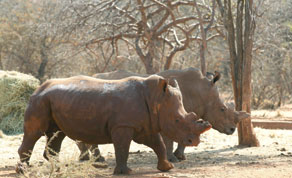
Rhinos with cut horns walk at a farm of Dawie Groenewald, who is accused of rhino poaching, in Musina, Limpopo province
More than 160 people are currently before the courts, exposing the complex supply chain stretching from South African parks to Southeast Asian consumers, said Joanie Spies, a prosecutor with the Rhino Project.
“Slowly but surely we’re moving upwards and getting higher people who did not pull the trigger,” says Spies.
The National Prosecuting Authority set up the team to help combat the dramatic surge in poaching that has seen more than 200 rhinos killed so far this year.
The cases have exposed corruption within the systems meant to protect the animals.
Private game owners, national park rangers and veterinarians have been arrested. Authorities have also caught pilots who flew helicopters to spot and dart the rhinos, and both small-time and professional hunters who shot them.
“There is a great level of organisation involved,” Spies said.
Some rhinos are shot by small-time hunters hoping for a lucky break by capturing a horn that sells for more than its weight in gold in Asia, where it is used in traditional medicine.
Not all of these hunters know what they’re doing. One man in April sawed off a horn from a fiberglass rhino serving as decor at a safari lodge.
Other rhinos are killed by professionals who have helicopter support in tracking and darting the animals before hunters shoot and de-horn them.
Whoever does the shooting, the horns can end up in the hands of the same Asian kingpins, Spies said. Vietnamese and Thai nationals have been arrested for trying to smuggle horns abroad.
In one case, Thai national Chumlong Lemtongthai faces trial for colluding with a South African game farm owner to stage legal trophy hunts. He is accused of hiring Thai strippers and prostitutes as hunters who posed with the massive beasts’ carcasses to document the kills to obtain some of the handful of legitimate export licenses for mounted rhino horns.
Authorities say he bought horns at around 65,000 rand ($8,400) a kilogramme and resold them for up to $55,000 a kilo.
Horns typically leave the country through Johannesburg’s international airport, or through the port of Beira in neighbouring Mozambique, where oversight is lax. The horns may transit in shipping containers or passengers’ hand luggage in Asian cities like Hong Kong.
Customs officials in Hong Kong say they have seized 52 horns over the past five years. Last year, 33 horns were found in a single container marked as carrying “scrap plastic.” It had come from Cape Town.
The biggest market for the horns is currently Vietnam, watchdogs say. “The resources that you would require to coordinate getting poached horns from South Africa to Vietnam means there is little doubt there are large, organised syndicates involved in that,” Naomi Doak, of conservation group Traffic, said from Vietnam.
So far, prosecuting the top levels of such syndicates has been an elusive goal. Cracking a syndicate requires piercing through three or four layers of crime, Spies said.
Spies said South Africa is stepping up its efforts by creating a combined task force of police, military, prosecutors and environmentalists. “You get better convictions, better sentences.”
Police arrest South African game farm owner and partners in crime, seize assets worth $7mn
South African authorities yesterday seized assets worth almost $7mn of a game farm owner and two veterinarians accused of rhino poaching, police said.
Prosecutors, police and environmental officials “seized assets in the region of 55mn rand ($6.8mn) believed to have been acquired through criminal activities, particularly rhino poaching,” national police spokesman Vishnu Naidoo said in a statement.
The assets were seized from game farm owner Dawie Groenewald and two veterinary surgeons, Karel Toet and Manie Du Plessis, he added.
Groenewald is the alleged mastermind of a poaching ring who legally bought rhinos, but then slaughtered them to sell their horns.
A helicopter and the animals on Groenewald’s farm, including rhinos, will be confiscated until the verdict in their trial. Groenewald, who is out on 1mn-rand bail, has denied the charges against him.