


AFP/Paris

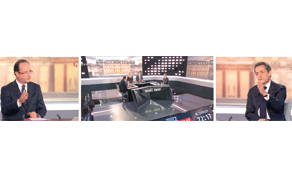
The clocks show equal timing for Hollande and Sarkozy, seen with journalists David Pujadas (second right) and Laurence Ferrari, in this video grab image from France 2 Television, at the end of their
televised debate at the studios in La Plaine Saint-Denis, near Paris
Nicolas Sarkozy’s re-election bid got tougher yesterday after he failed to land a much-needed knockout blow on Socialist frontrunner Francois Hollande in a fiercely fought televised debate.
Wednesday night’s debate was ferocious, with many French commentators surprised at Hollande’s combativeness, while allies of Sarkozy – called hyperactive and aggressive in the past – now accusing Hollande of being the same.
Sarkozy had hoped to dominate, but instead Hollande shed his image as a soft consensus builder to repeatedly attack the incumbent, countering critics and boosting his presidential stature ahead of Sunday’s run-off.
Sarkozy himself said yesterday that “an election has never been so uncertain” and the run-off “is going to be very close”.
“I thought it would be bitter and it was ... but the debate was about my proposals,” said Hollande, who on Wednesday night had introduced 16 policy proposals in a row with the phrase “I, as president...”
Newspaper editorials agreed that the debate “would not bring about an electoral earthquake” – with Hollande still forecast to win Sunday’s run-off with 53-54% of votes, according to opinion polls.
The right-wing incumbent has trailed in opinion polls for more than six months, and in the debate a clearly frustrated Sarkozy called Hollande a “liar” and “arrogant” several times.
Hollande’s response was sometimes mocking, accusing Sarkozy of refusing to take responsibility for his record and of self-satisfaction in a period of grim economic crisis for many voters.
“Francois Hollande’s only weakness compared to Nicolas Sarkozy, that he’s viewed as soft and blurry, was overcome last night,” said Gael Sliman of the BVA opinion poll institute.
A total of 17.79mn people watched the almost three-hour duel, said audience monitor Mediametrie, down on the 20.4mn who watched Hollande’s former partner, Socialist Segolene Royal, take on Sarkozy in 2007.
“Public opinion will view this debate as a draw, with an advantage for Francois Hollande only because Nicolas Sarkozy is the incumbent,” said political analyst and Socialist Party adviser Gerard Le Gall.
The pro-Sarkozy Le Figaro had a surprisingly neutral headline “High tension” although an editorial laid into Hollande’s roots in a left wing that is better at “speaking about its past than imagining the future”.
“Hollande had the advantage of never having exercised power. An enormous advantage when taking on a president whose time in office has been marked by an unprecedented financial crisis,” wrote Paul-Henri du Limbert.
The left-leaning Liberation daily headlined “Hollande presides over the debate”, with an editorial noting that the two men “clearly wanted a fight”.
“The damaging, violent political climate of the end of this campaign also reigned in the dark studio hosting the debate,” wrote editor Nicolas Demorand.
Le Figaro was the only newspaper still predicting a possible Sarkozy victory against Hollande with his “dated language and a disparate left”.
Interior Minister Claude Gueant, a close aide to Sarkozy, said that Hollande was “full of arrogance, full of self-importance” while also admitting that he had been “very pugnacious” during the debate.
The head of Sarkozy’s UMP party, Francois Cope, said that voters would “shuffle the deck” between the two rounds.
“Sarkozy pushed Hollande ever further back, to the point that Hollande stumbled, which he immediately made up for with a certain aggression,” said Cope.
Two days before campaigning ends tonight, the run-off candidates are to hold rallies on friendly territory: Toulon on the south coast for Sarkozy and Toulouse in the southwest for Hollande.