


AFP/Moscow
 |
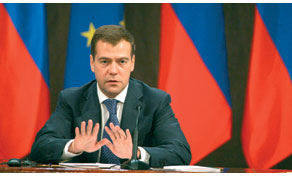
| Medvedev: has accused the council of being politically motivated |
“We know that you are also not happy with the results of the reforms,” said council head Mikhail Fedotov, calling on the government to involve the public in making new legislation.
Although the council’s experts worked on several reforms initiated by Medvedev, eventually their advice was ignored, Fedotov said.
He said that their input was “nullified” in developing the new police law and that they “were simply pushed aside” in preparing legislation on a new independent television channel, Medvedev’s latest initiative.
In remarks carried on Russia’s state channels, Medvedev accused the council of being politically motivated and ignoring cases that were not famous.
“In all, sometimes it seemed that the council is interested in solving only high-profile, publicised cases” like those of Mikhail Khodorkovsky and Sergei Magnitsky, Medvedev said.
Oil tycoon Mikhail Khodorkovsky is set to stay in jail until 2016 after being convicted in two fraud trials that his supporters say are politically motivated.
Lawyer Sergei Magnitsky died in 2009 under arrest in a fraud probe after exposing a corrupt scheme used by officials to siphon $235mn.
Medvedev created his human rights council of about 30 experts and NGO leaders in 2009, one year into his term, saying that it would help foster reforms and civil society.
But over the years it lost several prominent members who said they no longer saw the point.
“Three years of working on the council ... convinced us that respect for rights and freedoms of Russian citizens is not a priority for the president and his team,” journalists Svetlana Sorokina and Irina Yasina said in December, quitting the group over fraudulent parliamentary polls.
“We receive dozens of letters from people, but bureaucrats don’t exactly rush to solve them,” said group member Yelena Panfilova, who heads Russia’s office of Transparency International.
She said Medvedev promised to continue working with the council, but its fate would be a prerogative of Vladimir Putin, who will take office on May 7.
“The system defends itself,” she told AFP, “sometimes the president is not enough to do anything.”