


AFP/Minsk
 |
|
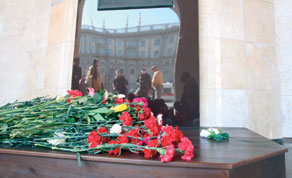
The reflection of mourners and flowers are seen at the monument to the victims near the entrance to the Oktyabrskaya (October) metro station on the first anniversary of a bombing attack in Minsk. |
All day passers-by piled flowers outside the entrance to the metro station in central Minsk, where the bomb exploded on a platform during the evening rush hour.
At the exact time of the blast, 5.56pm local time (1456 GMT), a city official unveiled a plaque with names of the victims outside the station, watched by relatives of the victims, who laid flowers and candles, many of them crying.
One elderly woman who declined to give her name leaned on a stick as she described how she lost her daughter-in-law in the attack, three months after the death of her son, who took part in the Chernobyl disaster clean-up.
“I was going to meet my daughter-in-law on the metro platform, but my train went past without stopping. Later I learnt that she was among the victims.”
The country’s strongman leader Alexander Lukashenko, who had gone into the metro station to view the chaos after the bombing, did not attend the ceremony.
The relatives were then taken by bus to a church in central Minsk for a remembrance service.
Lukashenko spearheaded the investigation into the attack, the country’s worst by far since its independence from the Soviet Union, and two suspects were swiftly detained.
The young men, both factory workers, were found guilty of carrying out the bombing and several earlier explosions. But the speed of the trial and the apparent lack of motive raised questions among the opposition about their guilt.
One of the men, Dmitry Konovalov, pleaded guilty but the other, Vladislav Kovalyov, in court retracted his confession, saying that it was made under pressure from investigators.
Kovalyov’s mother Lyubov led a tireless campaign to rehabilitate her son, complaining to the UN Human Rights Committee. But Lukashenko refused to pardon her son, saying that the crime was too atrocious.
The men, both 26, were executed in mid-March, with families only notified later.
The European Union had urged Belarus, the only country in Europe that still enforces the death penalty, not to carry out the executions by shooting and to introduce a moratorium.
Opposition channel Belsat, which broadcasts from Poland via satellite, was due to show the premiere of a documentary titled Fear in the Country of Calm, questioning the official version of events.