


AFP/Athens
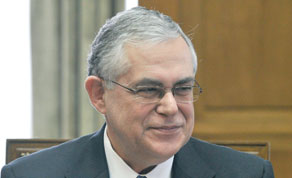
Greece’s Prime Minister Lucas Papademos has set the stage for early elections on May 6 by submitting his resignation to the country’s president after heading a five-month debt rescue.

Papademos: Parliament is dissolved but the government is not
Papademos formally resigned to President Carolos Papoulias yesterday after telling the cabinet that a May 6 ballot was necessary to secure a new mandate for reforms to return Greece to growth and secure its place in the eurozone.
“These challenges constitute a national issue of exceptional importance whose handling must be undertaken by a government with a renewed popular mandate,” Papademos told ministers according to his office.
“I recommend that a proposal be made to the president to dissolve parliament and hold elections on May 6,” he said.
No statements were made during or after the meeting with Papoulias but the outgoing prime minister is expected to make a nationally televised address later.
Papademos said the new parliament should be convened on May 17.
Under the constitution, the president will dissolve the current parliament and call for elections within 30 days.
Papademos, a former European Central Bank vice-president appointed as caretaker prime minister five months ago to complete a debt-saving deal for Greece, told the cabinet that the next government must draw up a new economic plan for 2013-2016.
The country must also pursue structural reforms to restore growth and keep its place in the eurozone, he said.
Papademos is expected to stay on to supervise the electoral process, along with most of his key ministers.
“Parliament is dissolved but the government is not,” he told the cabinet.
“Not a day must be lost ... this electoral campaign is not like previous ones,” Papademos added.
Among pressing issues is the recapitalisation of Greek banks that took a hit in a bond swap last month that erased nearly a third of the country’s near- and mid-term debt, which still exceeds 350bn euros ($461bn).
Legislation on the recapitalisation will be submitted for a vote by the incoming parliament in mid-May, a government official said.
The union of photojournalists staged a protest outside the presidential mansion during the meeting to demand justice for their chairman, who was operated last week after being struck on the head by a riot police officer during an anti-austerity demo.
“Police violence cannot stifle the truth,” read a banner held by the photojournalists whose members have often been subjected to police violence.
Papademos took over in November as head of a coalition backed by the conservative New Democracy party and the socialist Pasok party to complete the bond rollover and ratify a eurozone bailout worth 130bn euros ($171bn).
The bailout was ratified by Greek parliament last month and Athens has given private investors until April 20 to join the debt exchange.
Parliament on Tuesday approved a labour bill restructuring social security funds, the final piece of legislation that Papademos’s government had pledged to pass before the ballot at the behest of Greece’s creditors, the EU and International Monetary Fund (IMF).
Most analysts have warned that the electoral campaign will be the most uncertain in decades, owing to mounting anger over two years of painful austerity that has seen the creation of several splinter parties.
Private television station Mega on Monday released a poll giving New Democracy a four-point lead over Pasok, which is narrowing the gap under its new leader, former finance minister Evangelos Venizelos.
The survey by pollsters GPO suggests that with 18.2% of the vote, New Democracy may be unable to form a government.
Nearly one in five respondents did not give a party preference and more than 3% said they would support a neo-Nazi party, giving it enough votes to enter parliament.
But New Democracy leader Antonis Samaras told Mega on Monday that he would not join forces with Pasok to form a government if his party failed to garner enough votes, even if this meant new elections.
“If a government cannot be formed ... we will have to hold fresh elections, even if the country remains without a government (until then),” the conservative leader said. “I don’t trust Pasok.”
Greece in June will attempt to chop another 11.5bn euros ($15bn) off spending by 2014 to meet conditions laid down under a previous EU-IMF debt rescue.
Most of the 1,200 people questioned in Monday’s poll said they wanted a coalition government and 56% took a dim view of Papademos’s legacy.
Elections were originally scheduled for next year.