


DPA/Warsaw
Storms, blizzards and road closures struck Europe as the continent continued to battle with sub-zero temperatures yesterday, while record house fires were reported in Poland as people struggled to keep warm.

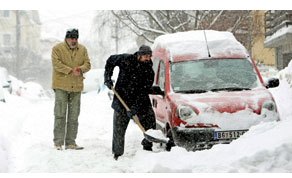
People clean snow from snow-covered street in Belgrade yesterday
A massive storm had continued whipping the Balkans for more than 30 hours by Sunday morning, depositing a huge amount of snow and triggering an avalanche in Kosovo that killed at least seven people.
Several were still missing in the southern Kosovo village of Restelice after an avalanche buried 15 houses under up to 10m of snow Saturday afternoon, the daily Koha Ditore said. All of the victims and the missing were apparently members of one family. Only one survivor, a 7-year-old child, was rescued.
To the north, Montenegro declared a state of emergency to deal with the massive blizzard that has blanketed the small central European country with up to two metres of snow.
By yesterday morning, the height of deposited snow in the ski resort of Zabljak had reached 202cm, while 168cm were measured in Kolasin, in central Montenegro, and 57 in Podgorica.
Many roads were impassable and villages, particularly in the north, inaccessible.
A train with 45 passengers was stuck between avalanches in the centre of the country since Friday afternoon, with one of the passengers dying, apparently of a heart attack, TV Vijesti said yesterday.
Still onboard were 30 police commandos who reached the train in a rescue attempt, but also became stuck. The train was parked in a tunnel, for shelter from avalanches.
In Poland, officials called Saturday’s the most “tragic night” of this season after nine people died in house fires and another 26 were injured in ill-fated attempts to heat their homes.
More than 100 people have now died this year in fires in Poland, with half of those deaths occurring since the cold snap began last month, police said. Firefighters appealed for people to keep their space heaters well away from the furniture, and to turn them off when leaving their homes.
In Serbia, the authorities reported a 20th death caused by freezing. The country’s power grid was strained to the very limit, prompting officials to urge the population to limit their consumption of electricity. Seasonal holidays were extended and schools were to remain closed in a bid to save energy.
Snow was still falling yesterday in Croatia and is expected to continue until today. Two ice-breakers from Hungary began crushing ice on the frozen sections of the Danube, the Vecernji List daily said.
Parts of the Adriatic highway remained closed due to gale force wind from the sea and snow.
The sun began shining in Rome after two days of snow and rain, but in other parts of Italy road access to dozens of villages was blocked due to icy conditions which began hitting the country last week.
In north-eastern Trieste, at least 10 people were injured when winds with speeds of more than 130kph lashed the Adriatic port city.
Heavy snowstorms were reported in Italy’s northeastern Veneto region and in the central Marche, where conditions forced the temporary closure of the city of Ancona’s airport, local media reported.
Airports were also temporarily closed in the towns of Rimini and Forli, in the central Emilia-Romagna region.
On Saturday, around 80 incoming flights - almost a quarter of the total - and 62 outgoing flights, or nearly a fifth of those scheduled, were cancelled at Rome’s main Leonardo Da Vinci and Ciampino airports, officials said. “The situation is now back to normal,” an airport spokeswoman said yesterday.
In Bulgaria, meanwhile, officials announced code yellow for 17 regions as heavy snowfall was expected to continue, the Sofia News Agency reported.
Heavy snowfall blocked more that 80 roads in southern Romania, local media reported.