


 |
| Hollande has taken a strong lead ahead of the French presidential vote, with polls showing him taking 28% to 30% of votes in the first round, against 23-24% for Sarkozy |
German Chancellor Angela Merkel has dismissed criticism of her support for French President Nicolas Sarkozy in his re-election battle, insisting it was normal that she back a fellow right-winger.
Merkel has come under fire from critics at home for interfering in French domestic political affairs and Sarkozy has been accused of aligning France’s interests too closely with those of its powerful neighbour.
France goes to the polls in less than 80 days, but both leaders played down the issue at a Paris news conference held after a joint Franco-German cabinet meeting and ahead of a joint television appearance.
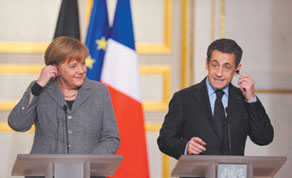
“I support Nicolas Sarkozy on all levels because we belong to political parties that are friends,” a cheerful-looking Merkel said. “It is normal that we support parties that are friends.”
Merkel recalled that Sarkozy had supported her in 2009 during her own election campaign, and said the French leader’s Socialist opponent Francois Hollande had recently come to Germany to address the opposition SPD.
Sarkozy, also smiling, thanked Merkel for her “friendship and trust” and – without citing him by name – slammed Hollande’s plan to renegotiate a eurozone fiscal compact seen by Berlin and Paris as a solution to the debt crisis.
He also denounced critics, in particular from the left, who have slammed Sarkozy for taking inspiration from the German model in efforts to reform France’s faltering economy.
“We are not jealous of them (Germany), we want to draw inspiration from them,” Sarkozy said, warning his opponents against “playing with feelings that remind us of periods that we do not want to see again”.
France and Germany were once seen as the twin motors of the European Union, but Paris is now clearly the junior partner, its economy lagging behind by any measure, and Sarkozy has turned to his fellow right-winger for ideas.
Sarkozy trails Hollande in the opinion polls and Merkel fears that any new left-wing French administration will diverge from her austerity plans.
Specifically, Hollande has said he will seek to renegotiate the hard-won eurozone “fiscal compact” that Merkel sees as essential to binding the single currency bloc together behind her deficit-cutting agenda.
Sarkozy, still smarting from France’s loss of its AAA debt rating, now cites Germany’s success almost daily to justify his own policies, drawing inspiration from both Merkel and her centre-left predecessor Gerhard Schroeder.
Along with tackling the eurozone crisis, the two leaders said they also discussed establishing a joint corporate tax.
Sarkozy said integration between France and Germany was aimed at “creating a stability zone that will strengthen all of Europe and the eurozone”.
In Berlin, Merkel’s spokesman said that the chancellor’s active support for Sarkozy’s re-election campaign was a “personal” engagement as leader of Germany’s centre-right party and not as the nation’s chancellor.
Insisting that Germany is “of course not a party in France’s election campaign”, Georg Streiter said: “It’s a question here of personal involvement by the CDU leader Angela Merkel.”
Merkel, who heads the conservative Christian Democratic Union, took several ministers to Paris yesterday for the joint Franco-German cabinet session and appeared with Sarkozy on French and German public television later in the day.
According to CDU general secretary Hermann Groehe, Merkel plans to support Sarkozy at campaign rallies ahead of France’s two-round presidential election, with a first round on April 22 and a run-off on May 6.