


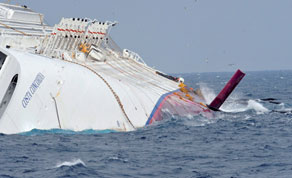
Reuters/Giglio Island, Italy
Divers searching for bodies on the Costa Concordia, the wrecked cruise ship that lies capsized off the Italian coast, suspended work yesterday after heavy seas and strong winds caused the vessel to shift noticeably, authorities said.

Waves break off on the half-sunken shipwreck of the Costa Concordia cruise liner. Instruments showed that the ship has shifted 3.5cm within six hours. The ship is lodged on the underwater boulders upon which it ran aground, but still can tilt as it settles. Too much movement is dangerous for the divers who continue to search the 290m-long vessel
Operations to begin pumping fuel off the ship had already been called off because of bad weather a day earlier, but the search for bodies had continued and a 17th body was recovered on Saturday.
The victim, a woman, was identified as a member of the crew, leaving one body so far unidentified and 15 people still missing after the disaster on January 13.
“There was greater movement caused by heavy seas, wind and low tide and as a precaution, operations have been suspended,” a spokesman for the rescue authorities said.
He said that measuring instruments placed on board the 290m-long ship showed some 3.5cm of movement in six hours, compared with a normal movement of 1-2mm.
The ship lies half-submerged just metres from shore on a rock shelf near the Tuscan island of Giglio where it ran aground and foundered more than two weeks ago.
Officials have said it is stable and faces little immediate risk of sliding from its resting place in some 20m of water into deeper waters.
However, even the slight movements posed a potential risk to divers exploring the ship’s dark interior.
With cloudy and windy weather and choppy seas expected to worsen in coming days, salvage crews are not expected to be able to start pumping the more than 2,300 tonnes of diesel fuel from the ship until the middle of the week.
The operation, aimed at preventing an environmental disaster in the pristine waters of a marine nature reserve, is expected to take between three weeks and one month.
The 114,500-tonne Concordia struck a rock which gashed its hull and caused it to sink after it sailed to within 150m of the shore to perform a display manoeuvre known as a “salute”.
Its captain, Francesco Schettino, has been placed under arrest and faces charges of multiple manslaughter and abandoning ship before the evacuation of more than 4,200 passengers and crew was complete.
An extended legal battle is now in prospect after lawyers in the United States and Italy launched class action and individual suits against the ship’s owner Costa Cruises, which is a unit of Carnival Corporation, the world’s biggest cruise operator.