


AFP/Abuja
Nigerian President Goodluck Jonathan said yesterday that violence blamed on Islamist group Boko Haram was worse than the country’s 1960s civil war, with sympathisers of the sect in government and security agencies.

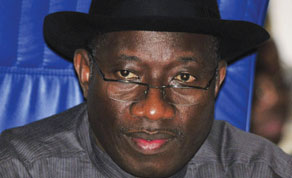
Jonathan: enemies within
“The situation we have in our hands is even worse than the civil war that we fought,” Jonathan said at a church service, referring to Nigeria’s 1967-70 civil war that killed more than a million people.
The death toll linked to violence blamed on the Islamist group has not reached anywhere near that level, but Jonathan cited the unpredictability and pervasiveness of the threat.
“During the civil war, we knew and we could even predict where the enemy was coming from ... but the challenge we have today is more complicated,” he said.
Describing the extent of the problem, he said Boko Haram members and sympathisers could be found throughout society.
“I remember when I had a meeting with elders from the northeast and some parts of the northwest where the Boko Haram phenomenon is more prevalent,” he said. “Somebody said that the situation is bad, that even if one’s son is a member, one will not even know. That means that if the person will plant a bomb behind your house, you won’t know.”
He added that “some of them are in the executive arm of government, some of them are in the parliamentary/legislative arm of government, while some of them are even in the judiciary. Some are also in the armed forces, the police and other security agencies”.
There has long been claims of political links to factions of Boko Haram, which has been blamed for intensifying violence that has killed hundreds, including attacks targeting Christians and churches in recent weeks.
But it was the first time Jonathan made the case publicly in such strong terms. His comments come with his government under mounting pressure to stop the violence and amid warnings from Christians that they will defend themselves.
Jonathan is also under huge pressure over a controversial government move that ended fuel subsidies on January 1, causing petrol prices to instantly double. There have been increasingly volatile protests over the move and nationwide strikes are planned for today.
The head of Nigeria’s Christians has also compared the attacks on the faithful that have killed more than 80 people to the run-up to the 1960s civil war.
The stark warning from Ayo Oritsejafor, head of the Christian Association of Nigeria, on Saturday came with at least six gun and bomb attacks targeting Christians since Christmas having killed more than 80 people.
Attacks have seen victims gunned down while their eyes were closed in prayer in church, caught up in a gruesome bomb blast while leaving Christmas services and shot while gathering to mourn the death of a friend.
In the latest violence, residents said gunmen shot dead three people believed to be Christians as they were playing poker on Saturday night in the northeastern town of Biu.
Islamist group Boko Haram has claimed most of the violence, which has sparked fears of a wider religious conflict in a country whose 160mn population is roughly divided between a mainly Muslim north and predominantly Christian south.
A purported spokesman for the group a week ago gave Christians living in the north a three-day ultimatum to leave the region. In claiming subsequent attacks, the spokesman said they were in response to the ultimatum.
At mass yesterday in the capital Abuja, worshippers were frisked and made to pass through metal detectors upon entry – measures that have been in place for several weeks.
In the economic capital Lagos, which has not been hit by attacks, churchgoers were told to be on alert for any suspicious movements.
Oritsejafor said on Saturday that Christians would defend themselves, though he added that he was not advocating reprisals.
An emergency meeting of church heads concluded “that the pattern of these killings does suggest to us a systematic ethnic and religious cleansing”, Oritsejafor said. “We are reminded by the occurrences of these killings of the genesis of the civil war that took place here in Nigeria.”
The run-up to Nigeria’s 1967-70 civil war that left more than a million dead saw Igbos, who are overwhelmingly Christian, massacred in the country’s north.
An attack on Friday in the northeastern town of Mubi was a frightening reminder for many of the pre-civil war days, with 17 people gunned down as they gathered to mourn the death of an Igbo killed the night before.
Muslim leaders have reported that Muslims based in the southern Niger Delta region have started leaving the area in apparent fear of reprisals.
A Red Cross official said “there are movements, but not alarming for now”.
Boko Haram has been blamed for intensifying violence for months, but it has taken on a different dimension with recent attacks targeting Christians.
Bombings on Christmas, particularly one that killed 44 people as services ended at a Catholic church near Abuja, sparked outrage.
Under mounting pressure to act, President Goodluck Jonathan on December 31 placed areas hard hit by attacks blamed on Boko Haram under a state of emergency, but the violence has continued and expanded into other locations.
In a televised address to the nation on Saturday evening devoted to a controversial policy that has seen fuel prices skyrocket, Jonathan spoke briefly of the violence, saying the “mindless acts of violence ... are unfortunate”.
A number of the recent attacks, including in Mubi and in the cities of Yola and Gombe, have occurred in areas outside the emergency decree.
Officials in Adamawa state, where Yola and Mubi are located, announced a 24-hour curfew on Saturday.
Boko Haram is a shadowy group believed to have a number of factions with differing aims, including a hard-core Islamist wing and those with political links.
It launched an uprising in 2009 that was put down by a brutal military assault in which some 800 people were killed.
Since the group re-emerged in 2010, it has been blamed for increasingly sophisticated attacks, including the August suicide bombing of UN headquarters in Abuja that killed 25.
Meanwhile, Nigeria’s unions have vowed to push ahead with Monday’s strike amid increasingly volatile protests over petrol prices, which have more than doubled since the government ended fuel subsidies on January 1.
Some petrol stations had run out of fuel ahead of the strike as residents stocked up in advance.
Nigerian cleric angry over ‘religious cleansing’ comments
A senior Muslim cleric in Nigeria has accused a Christian leader of intimidation for saying recent attacks that have killed more than 80 people suggest “religious cleansing”.
Ayo Oritsejafor, head of the Christian Association of Nigeria, compared the killings to the run-up to the 1960s civil war which claimed more than a million lives.
“We find the utterances ... an intimidation and a threat to Nigerian Muslims,” Sheikh Khalid Aliyu, secretary-general of Jama’atu Nasril Islam (JNI), a umbrella grouping of Muslim organisations in Nigeria, told AFP.
Aliyu said: “Such pronouncements calling for ... Christians to defend themselves are unacceptable to us and are meant to wage attacks on Muslims”.
He said that Muslims bore the brunt of most Islamist attacks in the northeast of Africa’s most populous country.
At least six gun and bomb attacks blamed on Islamist group Boko Haram and targeting Christians have killed more than 80 people.
Aliyu said Oritsejafor’s comments were “reckless” and insulted the Muslim faith, but added “we will not take the law into our hands”.
He said that when hundreds of Muslims were killed in post-election violence in April last year and when Christians killed worshippers during the Muslim festival of Eid “did we threaten to attack anybody in revenge?”