


AFP/Paris
 |
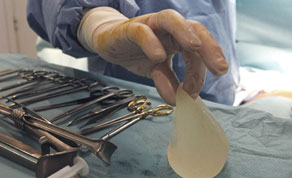
| Surgeon Denis Boucq pinches a defective silicone gel breast implant manufactured by French company PIP after he removed it from a patient in a clinic in Nice yesterday |
French Health Minister Xavier Bertrand said yesterday that Europe should impose stricter controls on medical devices in the wake of a scandal over allegedly faulty breast implants.
“For medical devices, we need other rules,” he told French television channel LCI amid a growing worldwide scandal over implants made by now-defunct French firm Poly Implant Prothese (PIP).
“A simple label is not enough,” he said. “I want to see changes in European regulation because unlike with medicine, which must be authorised to be put on the market, there are no (such regulations) with medical devices.
“There needs to be a sales authorisation, firstly for products that have a potential health risk,” Bertrand said, calling also for a toughening of testing procedures.
Le Parisien newspaper reported yesterday that PIP also made products for men, including buttock, testicular and pectoral implants.
It quoted a PIP employee as saying that most of these implants went abroad, particularly to Latin America.
Another paper, Le Figaro, said that for many years PIP was the official supplier of cancer clinics in France, where its implants were used to replace breasts for women who had lost them through disease.
A litany of accusations against PIP has triggered a worldwide scare, with several countries including France now advising thousands of women to have the implants surgically removed.
Around 300,000 women in 65 countries are believed to have PIP implants.
An unknown proportion are made with sub-standard gel which the firm, once the world’s third-largest silicone implant producer, used to cut its costs.
PIP was shut down and its products banned in 2010 after it was revealed to have been using a silicone gel that caused abnormally high rupture rates.
Fears over its implants spread globally last month after French health authorities advised 30,000 women to have their PIP implants removed because of the increased risk of rupture.
Officials have also said that cancer, including 16 cases of breast cancer, had been detected in 20 Frenchwomen with the implants, but have insisted there is no proven link with the disease.