


Reuters/Berlin
German Chancellor Angela Merkel gave her backing yesterday to President Christian Wulff, who has faced growing pressure to resign for trying to stop Germany’s top-selling newspaper from publishing an embarrassing story on a home loan scandal.

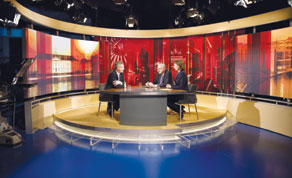
Wulff (left) being interviewed by Bettina Schausten and Ulrich Deppendorf at ARD Studios in Berlin
The scandal is becoming a major distraction for Merkel as she tries to focus on solving the euro zone debt crisis.
Critics say that it reflects badly on the chancellor’s judgment as she pushed for Wulff’s election in 2010 over a popular opposition candidate.
Were Wulff forced to step down, Merkel would face the difficult task of finding a successor and rallying her centre-right coalition behind a new candidate, a process that could take weeks and expose new cracks in her government.
“The chancellor has full confidence that the President will comprehensively answer all remaining questions,” deputy government spokesman Georg Streiter told reporters, adding that Merkel valued the president’s work.
But given the outrage in Germany over his conduct, it is unclear how long she can stand by Wulff, an affable 52-year-old conservative career politician.
Germans take the largely ceremonial office of president seriously.
The incumbent should be a moral authority who defends constitutional laws, including a commitment to protecting press freedoms.
Wulff’s trouble started last month with a report in top-selling Bild newspaper about a home loan at cheap rates that the president received from the wife of a wealthy businessman friend when he was still the premier of the northern state of Lower Saxony.
It emerged this week that Wulff had left an incandescent voicemail message for Bild’s editor before the story was published, threatening “war” and legal consequences if it was printed.
Several conservative allies and opposition lawmakers have turned on him in recent days, saying he is unworthy of the presidency.
German media criticism has been scathing.
“The overwhelming majority of the population can no longer take him seriously,” Vera Lengsfeld, a member of Merkel’s Christian Democrats (CDU), told Handelsblatt Online. “No new revelations are required to be certain that Wulff must go.”
Once popular due to his easy manner and mainstream views, Wulff was seen as a future rival to Merkel.
He even managed to retain his standing in the largely Catholic CDU after announcing he would divorce his wife of 18 years and marry a communications manager some 14 years younger than him.
Several lawmakers have already taken aim at Merkel, who was widely seen to have opted for Wulff to eliminate a potential rival.
Wulff was picked to succeed Horst Koehler, who resigned as president in 2010 after drawing criticism for saying Germany’s mission in Afghanistan served economic interests.
“Her cold power politics pushed out a respected and experienced president and replaced him with a politically and personally immature career politician,” Werner Marnette, a former CDU economy minister in Schleswig Holstein, told Handelsblatt Online.
The Sueddeutsche daily ran a comment saying that Wulff was not president due to his own merit, popularity or moral authority.
“Christian Wulff is president because the chancellor ... wanted him to be. If there is a rudimentary cause and effect principle, Angela Merkel must be called to account.”
“The woman who made Wulff president must tell him he cannot continue. Otherwise Wulffgate will become Merkelgate.”
German president admits making ‘grave mistake’
German President Christian Wulff admitted in a television interview yesterday that he made a “grave mistake” by trying to prevent a newspaper from publishing an embarrassing story about a home loan, but said he did nothing illegal and had no plans to resign.
Wulff had remained silent since news broke on Monday.
But with pressure growing for him to step down, he arranged an interview with German public television stations ARD and ZDF yesterday to try to calm the storm.
“The call to the chief editor of Bild was a grave mistake, for which I am sorry and for which I apologise,” Wulff said, admitting that had not done everything right but had broken no laws.
Asked whether he had considered resigning in the past few days, Wulff said: “No because I had great support in the past weeks from many citizens, my friends and employees. I like fulfilling my duties (as president) and have taken the job for five years and want to show at the end of the five years that I was a good, successful president.”
It was unclear whether the apology would be enough to ease the pressure on Wulff, a former state premier from Lower Saxony and senior figure in Merkel’s Christian Democrats (CDU), to step aside.
In the interview, he tried on several occasions to portray himself as a victim of the scandal, an approach which could backfire.
“This has been a learning process,” Wulff said. “I went from being a state premier to president very quickly, without time to adjust or prepare. It all went very fast, moving from Hanover to Berlin.”