


 |
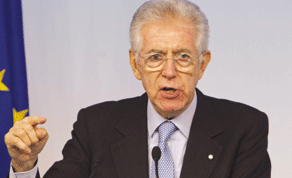
| Monti: we need a long-term sustainable approach |
Italy’s prime minister has warned European policymakers against dividing the continent with their efforts to fight its debt crisis, warning against a “short-term hunger for rigour” in some countries, in a swipe at Germany.
German Chancellor Angela Merkel gained some respite from domestic pressure to take a tougher line in the eurozone crisis when eurosceptics hostile to more bailouts lost a referendum in her junior coalition partner, the Free Democrats (FDP), aimed at blocking a permanent rescue fund.
Meanwhile, a first draft of a planned fiscal union treaty among eurozone countries and aspiring members, published yesterday, showed that countries could be taken to the European Court of Justice if they fail to meet agreed budget targets.
Merkel – under pressure from the revered Bundesbank to force debt-saddled eurozone countries to reform and save their way out of crisis with austerity measures – has led a push for automatic sanctions for deficit “sinners” in the bloc.
This has fed concerns that excessive belt-tightening in southern countries could send their economies into a negative spiral with no prospect of growing out of the crisis, while feeding resentment in the prosperous north.
Italian Prime Minister Mario Monti said that Europe’s response to the debt crisis “should be wrapped in a long-term sustainable approach, not just to feed short-term hunger for rigour in some countries”.
“To help European construction evolve in a way that unites, not divides, we cannot afford that the crisis in the eurozone brings us ... the risk of conflicts between the virtuous North and an allegedly vicious South,” he told a conference in Rome.
The head of Italy’s largest labour federation CGIL said on Wednesday that the country risks a “social explosion” over austerity measures, and unions plan more protests against them.
In Germany, turnout in the FDP bailout referendum fell short of the necessary quorum of one-third of the party’s membership, and only 44.2% voted for dissident lawmaker Frank Schaeffler’s motion against the planned European Stability Mechanism.
A victory for the eurosceptics could have brought down Merkel’s centre-right coalition, but the outcome still left the FDP split, with its public support in tatters.
The euro held steady above $1.30 yesterday and Spanish and Italian bonds rallied even though investors remain nervous of a possible Standard & Poor’s credit rating downgrade of several eurozone countries, including AAA-rated France.
French officials have sought to prepare the public for the likelihood that Paris will lose its top-notch rating for the first time since 1975, playing down the potential setback and focusing attention instead on neighbouring Britain.
“The economic situation in Britain today is very worrying, and you’d rather be French than British in economic terms,” Finance Minister Francois Baroin said in a radio interview, a day after Bank of France governor Christian Noyer said that if ratings agencies were even-handed, Britain deserved to be downgraded before France.
Britain’s Deputy Prime Minister Nick Clegg said that French Prime Minister Francois Fillon had called him to explain that “it had not been his intention to call into question the UK’s rating but to highlight that ratings agencies appeared more focused on economic governance than deficit levels”.
Clegg’s office said he accepted the explanation “but made the point that recent remarks from members of the French government about the UK economy were simply unacceptable and that steps should be taken to calm the rhetoric”.
Eurozone officials said the potential downgrade of up to 15 of the 17 eurozone countries could raise the cost of borrowing for the region’s existing EFSF (European Financial Stability facility) bailout fund but would not make a big difference to its operations.
EFSF chief Klaus Regling told the Rome conference there was about 600bn euros available to fight the crisis, more than Italy and Spain’s combined funding needs for 2012.
“If Italy and Spain were to ask for support their gross financing needs for 2012 are less than that and I don’t think they would need to be taken off the market,” he said.
The EFSF has the option of providing first loss insurance on new bond issues, but the country concerned would have to make a formal request and negotiate conditionality, while the sum guaranteed would have to be agreed unanimously by EFSF members, subject to German parliamentary approval.
Eurozone countries are to hold a conference call next Monday to agree on a boost to the International Monetary Fund (IMF)’s lending capacity, as part of measures to help cope with the debt crisis, to which they will commit 150bn euros, Slovak Finance Minister Ivan Miklos told Reuters.
The US has refused to offer any additional funding and it remains to be seen how much non-European economies such as China, Russia, Brazil and India are willing to commit.
The European Central Bank (ECB) has resisted calls to embark on unlimited purchases of eurozone sovereign bonds to quell the debt crisis, putting the onus back on governments and their collective financial firewalls.
ECB president Mario Draghi said on Thursday that eurozone governments were on the right track to restore market confidence and the ECB’s bond-buy plan was “neither eternal nor infinite”.
But in one intriguing hint yesterday, Bank of Italy governor Ignazio Visco told the Rome conference: “The impression is that there is only one way to convince markets and we’ll work on that.” He did not elaborate.
The comments came amid growing signs that banks are resisting pressure from governments to come to the aid of debt-choked eurozone countries by using cheap money lent by the ECB to buy more sovereign bonds.
With eurozone governments needing to sell almost 80bn euros of fresh debt in January alone, the stand-off between policymakers and banks could turn the slow-burning debt crisis into a conflagration in the New Year.
The chief executive of UniCredit, one of Italy’s two biggest banks, said this week using ECB money to buy government debt “wouldn’t be logical”.
In Italy, employers’ lobby Confindustria on Thursday slashed its 2012 gross domestic product (GDP) forecast, projecting a contraction of 1.6% from growth of 0.2% seen previously.
It said even that estimate was optimistic and based on a gradual easing of the eurozone debt crisis.
Monti’s government easily won a parliamentary vote of confidence yesterday for a package of tax hikes, spending cuts and pension reform aimed at meeting Italy’s goal of balancing its budget in 2013.
The measure goes to the Senate next week.
In Greece, where the debt crisis began two years ago, a senior official of the EU/IMF troika team negotiating terms for a second bailout package said there was no guarantee that talks on the private sector’s contribution would lead to a voluntary deal involving the bulk of its creditors.
Agreement has been held up by wrangling over issues ranging from the credit status and interest coupons on the new bonds to legal guarantees to be offered by the official sector.
Another key question is how many sign up to a private sector debt swap.
Failure to secure agreement could force a disorderly default which might in turn trigger a wider emergency across the eurozone.