


 |
|
|
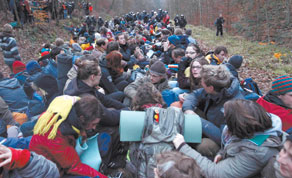
Thousands of protesters assembled in the northern German town of Dannenberg yesterday to meet a train carrying nuclear waste to a nearby storage depot.
Anti-nuclear demonstrators said that some 23,000 people took part in demonstrations against nuclear energy in general and the storage site in particular. The police spoke of 8,000 protesters.
After reloading in Dannenberg’s train depot, the material is to be transported to the storage site in Gorleben, a sparsely populated town of fewer than 650 people, located 20km further east.
Around 1,200 people blocked the tracks to prevent the train from reaching Gorleben, police said, adding that more were arriving.
Critics say the facility is not suitable to store nuclear waste, as salt in the ground could weaken containment structures and result in leaks.
The so-called Castor (Cask for Storage and Transport Of Radioactive material) transport, containing a cargo of 11 tightly-sealed casks of nuclear material, is slated to arrive later in the day.
The government has told citizens that waste will only be stored temporarily in Gorleben. But protesters are afraid that the site may become permanent.
Skirmishes along the route were more militant than in past years, with some protesters throwing rocks and incendiary devices, but police said the Dannenberg protesters were largely peaceful.
Anti-nuclear organisers said turnout was higher than they had anticipated.
About 20,000 police officers have been deployed to oversee the train’s journey to the controversial storage site.
On Friday, protesters clashed with police, on the French side of the border.
Throughout the night, police employed water canon and pepper spray to subdue protesters who threw smoke bombs at them and the transport itself. They also removed people splayed across train tracks.
The shipment is the last in a series of transports to be made from France to Germany.
The waste being moved Friday was produced in Germany and treated at a nuclear reprocessing plant in northern France.
Germany decided to phase out nuclear energy by 2022 in the wake of the Japanese nuclear accident in March this year, but has not found a permanent solution to storing its waste.