


 |
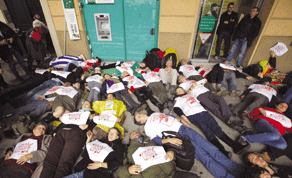
| Anti-G20 demonstrators lie in front of a bank in a protest against globalisation on the second day of the G20 summit in Nice |
France, whose year-long presidency of the G20 ended yesterday, had cheered non-governmental organisations (NGOs) by bringing issues like carbon emission limits and price swings for commodities onto their agenda last November.
But NGOs left unhappy from a summit in Cannes, dominated by fears Europe’s currency union might fall apart over a crisis in Greece. The euro drama claimed the focus of world leaders and media alike, knocking other issues down the agenda.
“It looks again like the (G20) communiqué will marginalise concerns most important for developing countries,” Soren Ambrose, head of development finance at Actionaid, a group devoted to fighting poverty, told journalists. “There was a full hearty meal for Greece ... but impoverished people are being fed crumbs.”
While NGOs hailed the fact that world leaders are thinking seriously about the idea of a financial transaction tax – derided as absurd by mainstream economists just a few years ago – they criticised lack of progress on hunger and climate change.
Brendan Cox, director of policy at NGO Save the Children, said the world’s 20 most powerful nations had ignored acute food shortages the Horn of Africa, leaving Mexico to forge a global response to problems linked to poverty.
“Twelve months ago the G20 promised a safety net for the world’s poorest, major reforms to the world’s dysfunctional food system and the possibility of billions of dollars in development finance,” he said. “But a crisis on the summit’s doorstep and a lack of political will have left the voices of the poorest almost unheard.”
Tasneem Essop, head of climate issues at the World Wildlife Foundation in South Africa, said language on climate change in draft communiqués had been watered down from France’s initial ambitions, suggesting that countries had used economic emergencies to wriggle out of commitments.
“Although we accept that resolving the problems of Greece is important we expected G20 leaders to find durable and sustainable solutions to the global crisis,” she said. “The French presidency managed to keep climate change on the agenda even though it is in a weakened form.”
Mexico’s presidency of the G20, which starts today, would bring the chance to return the focus to climate change, levies on carbon trading, development finance and “green growth”, Essop added.
Mexican President Felipe Calderon on Thursday urged the US and China – the top polluters – to agree on curbs of greenhouse gas emissions and set the stage for a greater focus on the environment.
“Mexico has been a leader in national and international climate policy,” Essop said. “We look forward to Mexico’s leadership.”