


Reuters/Mogadishu/Nairobi
Residents fled the Islamist-held town of Afmadow in southern Somalia yesterday and Al Qaeda-linked rebels rushed in reinforcements to hunker down for battle with advancing Kenyan and Somali government troops.

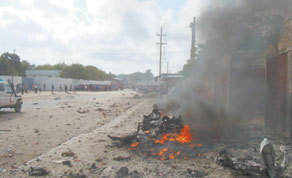
Civilians flee the scene of a blast in Mogadishu yesterday
Kenya launched an offensive with Somali forces on Sunday in a high-stakes bid to secure its porous border with its anarchic neighbour after a wave of kidnappings by gunmen thought to be linked to the rebels.
The operation is a major escalation that risks dragging Kenya deeper into Somalia’s two-decade civil war.
In the capital, Mogadishu, a suicide bomber killed six people outside a building housing two government ministries, the second bomb attack on government offices in the city this month. Shebaab claimed responsibility for the first explosion and warned more attacks would come.
The blast took place in the busy Kilometre 5 area near two hospitals and close to the foreign and planning ministries.
The suicide bomber struck about 3km from where a meeting between high-level Kenyan and Somali government officials had been taking place.
“At least seven people died including the bomber. Twenty others were injured,” said Ali Muse, coordinator of the ambulance service in Mogadishu.
“Most of the casualties were businessmen and customers who were at the spot where the car bomb unexpectedly went off,” Muse said, adding he thought the bomber could have been targeting a school building financed by Turkey.
Earlier, shopkeeper Farah Hussein said he saw three bodies, including one which appeared to be that of the suicide bomber.
“I see three dead people including the suicide car bomber who is totally burnt and ripped apart,” Hussein said.
Ambulances evacuated the wounded and government forces fired in the air to disperse a crowd which had gathered in the street, used by Burundian troops who form part of the Mogadishu-based African Union peacekeeping force to get to and from their base.
In a joint statement after the blast, Kenya and Somalia agreed they would carry out pre-emptive strikes on militants that threatened the security of either country.
Warplanes swooped low over Afmadow, a rebel stronghold. A senior commander of a militia group allied to the Western-backed Somali government said his fighters were stationed about 12km outside Afmadow as heavy rains slowed the advance.
“We are in the village of Cag Libaax, 12km to the west of Afmadow. We are heading to Afmadow but we are slowed by rains and muddy soils,” said Abdinasir Serar.
Afmadow resident Hussein Osman Roble said by telephone that most residents had started fleeing towards Dhobley, a border area which Kenyan military sources say has now been cleared of militants.
“Jets have flown low over Afmadow, terrifying the residents, while al Shebaab is digging trenches and tunnels for defense inside and around Afmadow,” Roble said.
Kenyan officials have remained tight-lipped on the details of the operation but a military spokesman said Kenyan troops were 100km inside Somalia in Qoqani, which is about 30km to the west of Afmadow.
“It’s difficult to estimate the length of our operation,” said Major Emmanuel Chirchir.
In a joint communique with the Somali government, Kenyan Foreign Affairs Minister Moses Wetang’ula said the spate of kidnappings was indicative of a change in strategy by Shebaab to “terrorise citizens”.
Both countries pledged to cooperate in “undertaking security and military operations in the Lower Juba (border) regions of Somalia and to undertake coordinated pre-emptive action and pursuit of any armed elements that continue to threaten and attack both countries,” the statement said.
Shebaab, which is waging an insurgency to topple a government it sees as a puppet of the West, urged Somalis to pick up arms and threatened retaliation against Kenya for the military operation.
A Somali army general said rebels were holding two Spanish aid worker hostages, and had moved them north to their coastal stronghold Kismayu as Kenyan and Somali forces closed in.
“Shebaab is holding them in Kismayu,” General Yusuf Hussein Dunmaal, who commands Somalia’s southern forces, said by telephone.
The militants have denied responsibility for kidnapping the Spaniards, seized from a refugee camp in Kenya where they were assisting fleeing Somalis, or for two other kidnappings of Westerners in Kenya. They say the kidnappings are being used as a pretext to launch the cross-border operation.
Shebaab threatened to take the “flames of war” back across the frontier if Kenya did not withdraw its troops. “The Mujahideen and all Somalis should fight back (against the) Kenyan troops that have invaded us,” a pro-Shebaab website quoted Sheikh Hassan Abdullahi Hirsi, a senior Al Shebaab official, as saying.
Shebaab has assembled columns of fighters and dozens of battle-wagons mounted with heavy machine guns, while remaining residents in Afmadow braced for clashes.
Separately, Kenya arrested two British citizens suspected of ties to Shebaab as they crossed the border into Somalia near to the coast.
“There are two British citizens who were arrested (on Monday). We suspect that they are coordinating the activities of Shebaab ... or maybe they were passing on information to these people,” deputy police spokesman Charles Owino said in Nairobi.
Owino said the two men, one of Somali descent, the other Pakistani descent, were seized in the border town Kiunga, just north of the Lamu archipelago. Kiunga is close to Somalia’s Raskamboni forest, a well known rebel hideout in southern Somalia.
Kenya, with East Africa’s biggest economy, has long looked nervously at its anarchic neighbour and its troops have made brief incursions into Somali territory in the past. This week’s incursion on a larger scale could invite reprisals.
“Shebaab has avoided attacks (inside Kenya) so far because it benefits too much from the illegal shipment of goods from Kismayu into Kenya and from financial supporters in the Somali community in Kenya,” said David Shinn, a former US ambassador to Ethiopia.
“Shebaab may conclude that the Kenyan action must be responded to, however, and the easiest way to do this is to carry out terrorist attacks inside Kenya. This would really ratchet up tension in the Horn,” he said.