


Reuters/Warsaw
Prime Minister Donald Tusk’s Civic Platform (PO) party is on track to win re-election when Poles cast their ballots in a parliamentary vote today, with turnout likely to determine the make-up of the next governing coalition.

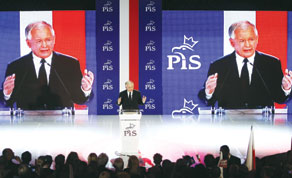
Kaczynski (above) and Tusk (right) speaking during the final pre-election convention in Warsaw late on Friday
The centre-right, pro-European PO enjoyed a stable lead over its main rival, the conservative-nationalist Law and Justice (PiS), in the election run-up, though its supporters are generally less determined to vote than PiS’s core constituency.
But it is the votes of younger urban Poles that in the past helped Tusk win elections and his party sought to mobilise them in the last stretch of campaign by highlighting the risks of a comeback to power by combative PiS leader Jaroslaw Kaczynski.
The PO and its current junior coalition partner, the Peasants’ Party (PSL), hoped for a higher turnout to given them enough votes to continue their alliance after the election.
Low turnouts have traditionally favoured Kaczynski’s party, which has a more loyal core constituency.
“Nothing is prejudged yet, we will be fighting for our coalition to the very end,” Foreign Minister Radoslaw Sikorski, who is also a deputy head of the PO, said this week.
Analysts said a lower turnout would likely translate into a relatively worse PO result, forcing it to seek a less natural coalition taking in the opposition Democratic Left Alliance (SLD) or the new libertarian Palikot’s Support Movement (RPP).
A CBOS survey said this week turnout could be up to 47%, though less than in 2007 when nearly 54% voted, giving the PO a clear-cut victory to oust Kaczynski.
As prime minister in 2006-07, Kaczynski antagonised many social groups over what he called the need to remove former communist regime collaborators from Poland’s public life.
His PiS won the 2005 parliamentary race in which less than 41% of Poles took part, the lowest turnout in general elections since Poland overthrew communism in 1989.
The PiS is known for staging strong election campaigns and opinion polls showed it narrowing the gap with the PO in earlier weeks of campaigning to as little as one percentage point.
But PiS gains in polls also tend to mobilise voters bent on blocking a Kaczynski return to power, and latest surveys again mostly show a wider gap between the two main rivals.
Today’s election is expected to decide the pace of Poland’s economic reforms. The PO is broadly pro-business and in favour of closer integration within the European Union.
Tusk has campaigned on Poland’s strong economic growth – expected to hit 4% this year.
He has vowed to pursue a steady rapprochement with Russia despite rows over issues from missile defence to gas pipelines and the conduct of an inquiry into a plane crash that killed Poland’s president last year.
Many analysts say that support for the more EU-sceptic Kaczynski has ebbed after he made remarks about Germany and Chancellor Angela Merkel in a new book that his rivals said were offensive.