


 |
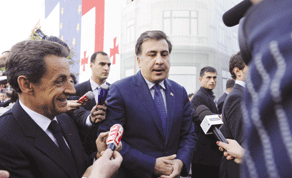
| Sarkozy with Saakashvili at Tblisi’s Freedom Square |
Sarkozy, in Armenia, his first stop on a visit to the Caucasus, called on Turkey to make a “gesture of reconciliation” and recognise the killings as genocide.
If it does not, he said, France “will consider it must go further to amend its legislation to penalise this denial”.
Sarkozy warned the measures could be adopted in “a very brief” timeframe but said the comments were not an ultimatum.
The challenge by the president of France – which opposes Turkey’s bid to join the European Union – drew an angry rebuttal from Ankara.
Turkey’s foreign minister said that France should confront its colonial past before giving lessons to others.
The French “do not have the right to teach Turkey a history lesson or call for Turkey to face its history”, Ahmet Davutoglu told a news conference.
Armenia, backed by many historians and world parliaments, says that some 1.5mn Armenians died during the upheaval that accompanied World War I, and calls it genocide.
Ankara rejects the term genocide and says large numbers of both Christian Armenians and Muslim Turks were killed.
“It would be better ... if Monsieur Sarkozy abandons the role of historian and puts his mind to getting his country out of the economic gulf in which it finds itself and comes up with plans for the future of the European Union,” European Affairs Minister Egemen Bagis said.
“Our mission, as politicians, is not to define the past or past events. It is to define the future,” he added on a visit to Sarajevo, quoted by the Anatolia news agency.
French Interior Minister Claude Gueant, in Ankara to sign a security agreement, told journalists not to “over-interpret” Sarkozy’s remarks, saying he had set Turkey no deadline.
Asked how Paris would react if Turkey were to recognise the colonial repression in Algeria as genocide, Gueant said Sarkozy had been in Algeria and expressed himself in strong terms “on this painful moment of our past. “He has turned the page.”
Sarkozy courted some 500,000 Armenian diaspora votes in France and angered Turkey before his election in 2007 by backing legislation that would prosecute those who denied the deaths were genocide. The measure was rejected by the French lower house of parliament.
Sarkozy was also to visit energy-producing Azerbaijan and Georgia, a transit nation for Caspian Sea oil and gas headed for Europe, during his trip to the ex-Soviet states of the Caucasus.
He urged Armenia and Azerbaijan to resolve their dispute over Nagorno-Karabakh, a mainly Armenian-populated enclave in Azerbaijan, which led to war in the 1990s.
Armenian-backed separatists wrested Nagorno-Karabakh from Azeri control after the Soviet Union collapsed, in a conflict that killed 30,000 people and drove 1mn from their homes.
France, Russia and the US have led years of international efforts to mediate a peace deal after a 1994 ceasefire.
Two Azeri soldiers and an Armenian were killed in a skirmish on the ceasefire line on Wednesday.
The conflict prompted Turkey to close its border with Armenia in 1993 in solidarity with Muslim ally Azerbaijan and its refusal to term the Ottoman Empire killings genocide is now the main obstacle to renewing diplomatic relations.
“The time has come to take the risk of peace,” Sarkozy said at a meeting with Armenian President Serzh Sarksyan. “Armenians, Azeris and Turks: You must choose this path. There is no other, it is the path of peace.”
Later in Georgia, Sarkozy told thousands of cheering Georgians that Russia must stop making “threats” and intimidating its neighbour after their brief 2008 war.
“France sees Russia as its friend, as a strategic partner. But to restore confidence, intimidation, threats and attempts to destabilise (the situation) are fully unacceptable,” said Sarkozy.
At an elaborately-staged rally on Tbilisi’s Freedom Square to welcome Sarkozy on his first return to the country since the deal was finalised, the French leader stressed that he was committed to “the sovereignty, independence and territorial integrity” of Georgia.
Georgia accuses Russia of violating the agreement and its sovereignty by not pulling its troops back to pre-war positions and “occupying” the rebel provinces of Abkhazia and South Ossetia, which Moscow recognised as independent states after the 2008 conflict.
Sarkozy insisted that Russia must withdraw its forces in line with Moscow’s “word and honour”.
“Against all strategic logic and contrary to undertaken commitments, significant military forces are still stationed and were reinforced,” he said.
The strong comments delighted Tbilisi but will irritate Moscow, which says its troops were invited by sovereign states to protect them against attempts by Georgia to seize back territory it no longer controls but still claims.
Russia’s recognition of the two rebel Georgian provinces came shortly after the war and was followed quickly by its refusal to deal directly with the pro-Western President Mikheil Saakashvili.
But in firm remarks that echoed the two sides’ recent split over action in Libya and Syria, Sarkozy noted that Russia must stop the Soviet-era practice of bossing territories that once answered to Moscow.
“Everyone must admit that the Soviet Union does not exist anymore and that a policy of spheres of influence is not intended to succeed it,” said Sarkozy.
“Everyone must admit that Georgia, like any other country, has the right to define its path and to freely choose its friends and its alliances. It must be free to express its aspiration to join Nato, if its people wish.”
In unusually encouraging words that drew cheers from his Tbilisi audience, Sarkozy also held out the distant hope of EU membership for the impoverished Caucasus state, saying that Georgia also “must be free to express its aspiration to move towards the European Union and to one day join it”.
He cautioned however that any progress towards EU membership “depends, primarily, on your reforms and the deepening of your democracy”.
Saakashvili, who is no longer on speaking terms with Russian President Dmitry Medvedev and is set to remain in power until 2013, told the rally that he had no doubt where the country’s future lies.
“Georgia’s and Russia’s ways have parted. We choose Europe and we choose European democracy,” Saakashvili said.