


Reuters/Belgrade/Mitrovica
Nato peacekeepers in Kosovo (KFOR) yesterday brought in more troops to a contested border crossing in the ethnic Serb north, a day after more than a dozen people were hurt in clashes.

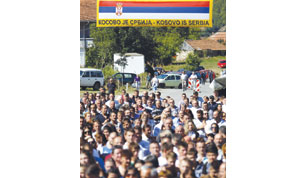
Local Serbs attend a protest in the village of Zupce near the town of Zubin Potok
Sixteen Kosovo Serbs and four peacekeepers were injured during the confrontation between KFOR troops and a Serb crowd rallying against the removal of a barrier.
Witnesses said KFOR soldiers used fire arms, teargas and rubber bullets. Serb officials said six protesters received serious gunshot wounds while others suffered minor injuries.
Nato said KFOR positions came under fire and that pipe bombs were thrown at peacekeepers.
KFOR troops yesterday reinforced their positions around the Jarinje border crossing, about 100km from Kosovo’s capital Pristina, deploying armoured vehicles, sand bags and barbed wire. Nato also warned it would use lethal force to protect its troops.
The clashes prompted Belgrade to cancel EU-mediated talks with Pristina in Brussels aimed at improving co-operation in areas such as the flow of people and goods, property rights and personal documents.
The talks will resume “when the Serbian side is ready to re-engage,” said Robert Cooper, who mediates on behalf of the EU.
Nato spokesman Ralph Adametz said the confrontation started when Serbs drove a vehicle at troops and tried to steal a weapon.
Kosovo Serbs pulled back yesterday several hundred metres from the Jarinje crossing, but remained at other barricades that prevented road access to the border post.
In the northern city of Mitrovica, masked Serbs yesterday attacked a group of ethnic Albanian and Roma workers at the Ibar river that divides the city and separates southern ethnic-Albanian and northern Serb parts of Kosovo, police said.
In a separate incident, Albanians from an ethnically-mixed neighbourhood damaged a car owned by a Serb.
Overnight, Serbs in Mitrovica stoned two police cars, a bank and attempted to burn two internationally-owned shops.
Officials in Belgrade - which opposes Kosovo’s independence, three years after it seceded from Serbia - said they were concerned there may be more incidents.
“We will try to prevent potentially explosive situations, but this is now becoming increasingly difficult,” government spokesman Milivoje Mihajlovic said. “Violence there was senseless and we want to know who ordered it.”
Serbia wants to join the European Union and will likely be granted candidate status by end-October, but it must mend ties with Kosovo to secure a date for accession talks.
Serbia faces a parliamentary election, expected in April 2012, and Kosovo will be high on the campaign agenda.
The Pristina government wants to reinstate its presence in the largely lawless northern Kosovo. On September 16, Pristina sent police and customs officials to two northern border crossings, Brnjak and Jarinje, previously staffed mostly by ethnic Serbs.
In response, Kosovo Serbs blocked roads leading to the border and laid a dirt track near Jarinje to bypass the crossing.
Violence in Kosovo’s north also flared in July when Pristina tried to enforce a trade ban with Serbia. One ethnic Albanian policeman died and Serbs torched the Jarinje border post.
Since 2008, Kosovo has been recognised as an independent state by more than 80 countries, including the US and most of the EU, but northern Kosovo, with a population of about 60,000 still pledges allegiance to Belgrade. The remainder of Kosovo’s 120,000 Serbs are living in enclaves in Kosovo.
Russia, a long-term ally of Serbia, called on Nato forces to observe neutrality in Kosovo.
“We are deeply concerned by the violence against the Serbian population, authorised by KFOR,” Russia’s Foreign Ministry spokesman Alexander Lukashevich said in a statement.
“We again urge ... KFOR and the European Union Rule of Law Mission (in Kosovo) to rigorously observe the principle of status neutrality.
“Appeasing the Kosovo-Albanian side contributes to the growth of its aggression, unwillingness to seek compromise solutions and take into account the interests of all the ethnic groups populating Kosovo.”