


 |
|
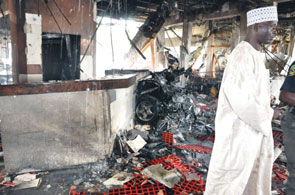
A man standing next to the debris of the car that rammed into the UN building in Abuja yesterday. The suicide bomber driving the car somehow made his way through a gauntlet of security at the UN’s main compound in Nigeria, forcing his way through the gate before ramming into the building, witnesses said. The explosion that resulted shook the area, blowing out the building’s first two floors, with visitors in the reception area getting caught up in the attack. |
UN Secretary General Ban Ki-moon said the final casualty toll was likely to be considerable and Nigerian President Goodluck Jonathan ordered tighter security around the capital after what he called a “most despicable assault”.
Security sources and witnesses said the car rammed into the building and blew up, badly damaging parts of an office complex where close to 400 people normally work for UN agencies.
“We do not yet have precise casualty figures but they are likely to be considerable,” Ban said.
“This was an assault on those who devote their lives to helping others,” he said in a statement. “We condemn this terrible act, utterly.”
Body parts were strewn on the ground as emergency workers, soldiers and police swarmed around the building, cordoned roads and rushed the wounded to hospital.
“Different people have been taken to different hospitals so we’re not sure of casualty figures. It is at least 18,” said Mike Zuokumor, Abuja police commissioner.
A man claiming to be a spokesman for the Nigerian Islamist group known as Boko Haram claimed responsibility for the attack.
“Through the wisdom of Allah, we have launched the attack with absolute precision,” the man who identified himself as Abu Darda said in a telephone call.
“The attack was carefully scripted and executed. We have said it several times that the UN is one of our prime targets.”
The veracity of his claim could not be verified, however.
The BBC also reported that a spokesman for Boko Haram had said in a phone call that it had carried out the attack.
Speaking before the BBC report, an Abuja-based security source said he suspected Boko Haram, whose strikes have been growing in intensity and spreading further afield, or Al Qaeda’s North African arm.
“This is...a serious escalation in the security situation in Nigeria,” the security source said.
In yesterday’s attack the car slammed through security gates of the UN complex, crashed into the basement and exploded, sending vehicles flying and setting the building ablaze.
“When the car got inside it went straight to the basement and exploded, killing people in reception, right and left,” said Abuja resident James John, who saw the attack. “The entire building, from the ground floor to the topmost, was just fire and smoke. I saw six bodies been carried. I can’t believe it.”
Michael Ocilaje, a UN employee at the complex, said: “All the people in the basement were killed. Their bodies are littered all over the place.”
The building, which housed 26 UN humanitarian and development agencies, was blackened from top to bottom. In places, walls were blown away and there were piles of debris.
Militant attacks in the oil-producing regions of southern Nigeria have subsided but the north has been hit by a round of bombings and killings by Islamist extremists.
Boko Haram, whose name translates from the local northern Hausa language as “Western education is sinful”, has been behind almost daily bombings and shootings, mostly targeting police in the northeast of Africa’s most populous nation.
The group claimed responsibility for a June bomb attack on the car park of the Abuja police headquarters which bore similarities to yesterday’s blast at the UN building.
In the June attack, a car rammed through the gates of the police headquarters in the capital and exploded, killing the bomber and narrowly missing the chief of police.
Boko Haram’s ambitions are growing and if it is confirmed to be responsible for yesterday’s attack, this would mark a shift beyond domestic targets.
In London, Henry Wilkinson, associate director at Janusian risk consultants, told Reuters the attack suggested Boko Haram had evolved from being a parochial faction to one that also threatened international targets in Nigeria.
“This attack will prompt many Western organisations and business to reassess the threat the group poses,” he said. “The targeting of the UN building indicates a more global outlook probably influenced by Al Qaeda ideology.”
In Abuja President Jonathan ordered tighter security. “The president believes that the attack is a most despicable assault on the UN’ objectives of global peace and security, and the sanctity of human life to which Nigeria wholly subscribes,” the state house said in a statement.