


By Justine Gerardy, AFP/Johannesburg
 |
|
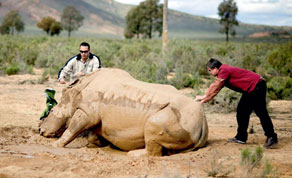
Searl Derman, Aquila Game Reserve’s owner (left) tries to cover the eyes of a badly-injured white rhino while veterinarian Doempies Trichardt (right) injects the animal with a sedative after poachers sawed off its horn |
The giant rhino slumps to the ground with haunting cries as it fights for its life, a bloodied, fleshy pulp in the place where poachers sawed off its horn.
The critically injured male is one of the latest victims in South Africa’s rhino bloodbath, which is surging on privately owned reserves as criminal syndicates target easier prey for the Asian black market.
“I’m at war,” says exhausted owner Searl Derman.
In a bid to protect his rhinos, Derman has racked up bills for tracking helicopters, vets and 24-hour anti-poaching measures. But he is competing with hunters who are chasing horns that fetch $50,000 a kilo.
“We did everything we couldn’t afford, and now we’ve got to double that,” said Derman, who is offering 100,000 rand ($13,800) for tip-offs on last Saturday’s attack. “I just wish it could be more. I want it to be equal or more than a rhino horn.”
The rhino later died, the second to die as a result of the attack on Derman’s private reserve two hours from Cape Town.
Rhino horn is used in Asian medicinal treatments for a range of ailments from fever to cancer, and sells for more than cocaine despite having no proven scientific medical value.
South Africa has lost 275 rhinos to poaching this year, up from 13 in 2007, with a recent swing to private reserves which hold about a quarter of the country’s rhinos.
“It was unheard of three years ago for animals to be poached on private reserves, but now this is happening on an ever increasing basis,” said Pelham Jones of the Private Rhino Owners’ Association, which estimates 450 to 500 rhinos will die in South Africa this year.
“When you go to these crime scenes, it is absolutely horrendous. You see really hardened, toughened bush men standing around a carcass and they weep. The emotional attachment to these animals is huge. You see yourself as a protector of a very vulnerable animal.”
The bloodshed is at such dizzying levels that South Africa in April sent its army into the state-owned Kruger National Park where the armed soldiers have slashed kill rates among the country’s biggest rhino population.
“The private sector does not have that and the poachers know that full well. It is easier to target a private reserve where it is commonly known the security assets are nowhere near the same level,” said Jones. “The private sector has now become the soft target.”
The 9,000-hectare Kariega Game Reserve in the Eastern Cape, where three attacks have meant losses of 1mn rand, has dehorned its rhinos in hard-to-patrol areas and has a team guarding the rest of the animals.
“I don’t believe that it’s sustainable economically for private reserves to fight the problem directly on the ground,” said owner Graeme Rushmere, adding the war could be won only if demand was stamped out. Action from Asian authorities was also needed.
One controversial proposal is legalising the trade in rhino horn, made of the same substance as human fingernails - keratin - and valued at up to $500,000 per horn, according to CITES (the Convention on International Trade in Endangered Species).
Advocates say it would cut down on illegal poaching if rhino horn could be harvested from live animals, or sold from rhinos that die of natural causes or in licensed hunts.
Jones said the Private Rhino Owners’ Association supports such a move. “Failure is not an option,” he said. “But as we currently stand, the species will go into population decline at the current offtake in about the next 18 months. So we really do not have a lot of time on our hands.”
The Aquila Game Reserve, where the dehorned male rhino died, is the western-most spot to suffer a deadly attack in South Africa to date. “We’re all facing the threat,” said Derman. “We’re all scared and we all can’t afford it.”