


Reuters/Harare
President Robert Mugabe appealed for tolerance and peace between Zimbabwe’s leading political parties yesterday after the death of a retired army general sparked speculation that he was murdered.

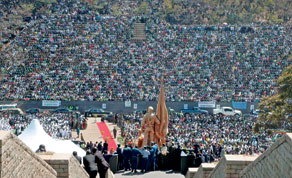
Thousands of mourners gather at the National Heroes Acre for the burial of Mujuru
Speaking at the burial of General Solomon Mujuru, 67, who was burnt to ashes in a bizarre fire at his home, Mugabe urged Zimbabweans to accept the death as an unfortunate and painful tragedy.
Mujuru, a leading figure in Mugabe’s ZANU-PF party for nearly four decades, was considered a kingmaker within the party and was married to Vice-President Joice Mujuru, who was backed by one faction in the party to succeed Mugabe as party and state president.
Mugabe praised Mujuru, popularly known by his guerrilla name Rex Nhongo, as a great soldier and freedom fighter whose legacy would be defended by his comrades and a strong security service.
“We don’t want any violence. Please, no violence, no violence. Let’s organise ourselves and campaign in our different parties peacefully,” he said, adding that they should build on a lull in violence between ZANU-PF and the Movement for Democratic Change (MDC).
The MDC led by Mugabe’s rival Prime Minister Morgan Tsvangirai says that war veterans and ZANU-PF’s youth brigades are behind the violence. ZANU-PF denies the charges.
The veteran leader told thousands of people at the funeral, including members of both parties, that the MDC and ZANU-PF must co-exist, but made no reference to media reports that his party is increasingly divided over who will eventually succeed him.
Mujuru headed the ZANU-PF faction that supported Joice Mujuru to succeed Mugabe. It had jostled against another faction led by Defence Minister Emmerson Mnangagwa.
Mugabe appeared to dismiss suggestions that Mujuru’s death was suspicious.
“It is hard to imagine that such a glorious soldier died in such an inglorious way, so uneventfully. But this is how God willed it and we cannot do anything about it, except to grieve, to ask so many questions and finally accept his demise even though it will always hurt,” Mugabe said in a statement.
There has been no suggestion either by the authorities or Mujuru’s wife of foul play, but private media reports say some family members believe the general was murdered.
Mujuru was Zimbabwe’s first black army commander after independence in 1980, after serving for some months under Rhodesia’s last white general Peter Walls, retiring in 1992 and becoming a member of ZANU-PF’s top organ, the politburo.
Political analysts say Mujuru’s death could lead to some bruising battles over the succession, but may nudge Mugabe to tackle the problem.
Many analysts say Mugabe, in power for 31 years and currently his party’s presidential candidate for elections expected in the next two years, is likely to have a big say on who succeeds him if and when he decides to step down.
There are unconfirmed reports that Mujuru was pressing Mugabe to step down before the next poll.
Mugabe was forced to form a unity government with Tsvangirai’s MDC after disputed elections in 2008. But their fragile coalition is haggling over democratic reforms.
Rhodesia no longer: No backtracking on indigenisation measures
Zimbabwean President Robert Mugabe said yesterday that his government would not backtrack on policies aimed at eliminating majority shareholdings of foreign- and white-owned investments.
Addressing mourners at the funeral of retired general Solomon Mujuru – who had been one of two leading contenders to succeed Mugabe in his ZANU-PF party – the president said that white people and the West must not continue to interfere in his country.
“We continue to say to the British, Americans and their allies, ‘get away from us’. Perhaps they do not know that it is no longer Rhodesia but Zimbabwe,” Mugabe said.
“We must never surrender the ownership of our resources,” he continued. “The people fought for their independence and their land. Let’s protect the legacy of the liberation war.”
“We fought so that we could be masters also,” the 87-year-old leader added. “That is why we need an empowerment act.”
The so-called empowerment policy has split Zimbabwe’s coalition government.
Mugabe argues that the policy is necessary so that black Zimbabweans benefit from the country’s lucrative mineral resources, while Prime Minister Morgan Tsvangirai has said it drives out the foreign investors needed to jump-start the ailing economy.
In June, parliament declared that the indigenisation regulations were “unconstitutional, unreasonable and absurd” and called for them to be repealed or revised.