


AFP/Rome
The UN food agency yesterday called for long-term aid for farmers in the Horn of Africa to “break the cycle” of hunger, saying constant crises in the drought-hit region should shame the world.

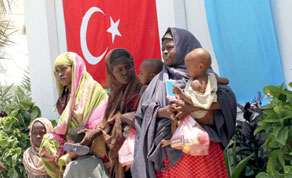
Internally-displaced Somali women with their children queue in front of a Turkish national flag outside a hospital in Mogadishu yesterday
As Turkey’s prime minister prepared to fly to war-ravaged Somalia, where the food crisis has hit famine levels, the Food and Agriculture Organisation (FAO) said efforts to tackle the situation were being hampered by lack of donor funds.
“It is unacceptable for more than 12mn people to be at risk of starvation today,” Jacques Diouf, head of the Rome-based FAO, said at the start of a conference on the drought crisis.
“The required funding is lacking. If governments and their donor partners do not invest now, the appalling famine we are now struggling to redress will return to shame the international community yet again.”
Diouf called for immediate food aid to help the worst affected but also emphasised the need for longer-term assistance to livestock farmers and crop producers to strengthen their defences against climate change.
The UN says it has received pledges for just over half of the $2.4bn required for relief efforts. The African Union is holding a donor conference in Ethiopia next week.
Equatorial Guinea said yesterday it was donating 2mn euros but the African response in general has been criticised as “very slow” by the South African aid group Gift of the Givers Foundation.
The UN has officially declared famine in parts of Somalia for the first time this century, including in Mogadishu and four southern regions controlled by Islamist militias who have blocked access for some aid groups.
Following a trip to Somalia this month, Cristina Amaral, FAO’s head of emergency operations, said the most urgent tasks were to prepare farmers for the October rainy season and to widen humanitarian access in southern Somalia.
“There is a lot still to be done but above all we want to alert people to the fact that we have to prepare for the next farming season,” she said.
“The only way that households can survive is through their livestock and their fields... so we have to help them to stay on their lands,” she said.
Tens of thousands have died and hundreds of thousands have fled in a crisis that has also hit Djibouti, Ethiopia, Kenya, South Sudan, Sudan and Uganda.
Kenyan Agriculture Minister Sally Kosgei complained at the meeting in Rome that long-term programmes to help farmers against drought were in place in Kenya but “do not seem to be taken seriously” by the international community.
Meanwhile, Turkish Prime Minister Recep Tayyip Erdogan is travelling to the Somali capital Mogadishu, a day after an emergency meeting in Istanbul of the Organisation of Islamic Cooperation (OIC) on the crisis. OIC members pledged $350mn for relief efforts at the talks.
“As drought deepens and the crisis worsens, time - especially for the very young and vulnerable - is not on our side,” Sheila Sisulu, deputy director of the UN’s World Food Programme (WFP), said at the Rome talks.
She also vowed “zero tolerance” against any diversion of the tons of food aid being sent to Somalia and neighbouring countries, following reports of theft from convoys that WFP says represent only a fraction of total supplies. “We must seize this opportunity to break the cycle of food insecurity,” she said.
Aid agency Oxfam meanwhile said it had begun airlifting 47 tons of water supply and hygiene materials to Mogadishu and warned about a rise outbreaks of cholera among women and children in overcrowded camps in and around the city.
Relief efforts have been ramped up in the capital following a surprise withdrawal by Al Qaeda-inspired rebels from the city earlier this month.
British International Development Secretary Andrew Mitchell visited Mogadishu on Wednesday and warned that without urgent action the crisis could become as bad as Somalia’s 1991-92 emergency, when more than 200,000 people lost their lives.
Action against cholera
Cases of cholera and acute diarrhoea are on the rise in southern Somalia and require a rapid response, the World Health Organisation and the UN children’s agency said yesterday.
Some 4,272 cases of cholera or acute watery diarrhoea have been reported in Banadir hospital in the capital Mogadishu alone since January, the agencies said in a statement.
Cholera has also been confirmed in four southern Somalia regions of Banadir, Bay, Mudug and Lower Shabelle and the number of cases has risen, the agencies said, even if most of the cholera cases “are contained and under control”.
About 75% of all cases of acute watery diarrhoea are among children under the age of five.
“There is no need for a child to die of diarrhoea, yet this is tragic reality for a Somali child who is acutely malnourished. It is a lethal combination,” said Rozanne Chorlton, UNICEF’s representative for Somalia.
Cholera is endemic in Somalia but the last major outbreak dates back to 2007 when 67,000 cases were recorded.