


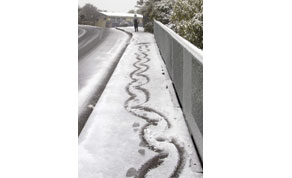
AFP/Wellington
 |
| A teenager has fun yesterday as he walks on a snow-covered street in the Wellington suburb of Johnsonville after a polar blast dumped snow on the city for the first time in decades |
Residents of hillside suburbs in the capital Wellington were warned that they faced being snowed in amid the worst winter weather in the North Island for half a century.
“People should prepare for the worst, which means making sure they’re ready in the event that they cannot leave home and may be without electricity and other amenities,” civil defence manager Rian Van Schalkwyk said.
WeatherWatch head Philip Duncan said that New Zealand’s largest city Auckland had its heaviest snowfall since the 1970s, although it was washed away by heavy rainfall.
“Aucklanders won’t have white-out conditions like Wellington, Christchurch or Dunedin but certainly a few isolated pockets of snow are likely mixed in with the rain,” he said.
The worst conditions were in the South Island, which is more accustomed to snowstorms but still struggled to cope with the severity of the blizzard, which is expected to deliver icy conditions for much of the week.
Airports were closed yesterday morning at Christchurch, Dunedin.
The resort town of Queenstown, where the official MetService recorded temperatures as low as -4 degrees Celsius (25 degrees Fahrenheit).
The main roads to Queenstown were also closed, leaving the South Island ski centre isolated, and the NZ Transport Authority reported more than a dozen highways around the country were impassable.
Power was cut to thousands of homes in Wellington, Christchurch and the Coromandel Peninsula, north of Auckland, while schools were closed across much of the lower South island.
The MetService said there would be little respite in coming days.
“The strong, bitterly cold southerly flow currently affecting the country is only expected to ease slowly during Thursday,” it said.