


Reuters/Johannesburg
 |
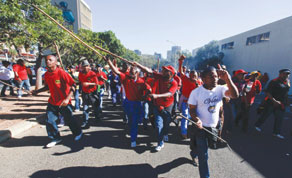
| Striking municipal workers march through the streets yesterday in Cape Town. The South African Municipal Workers Union (SAMWU) is demanding an 18% wage increase. Municipal workers across the country embarked on a second day of strike action downing tools and marching in protest. Some looting, vandalising and trashing of garbage bins across cities has been reported |
But while the mid-year negotiating session known locally as “strike season” is winding down, striking municipal workers set fire to rubbish heaps on the streets of Cape Town and looted road-side stands.
And in a separate dispute, trade union Solidarity said its members and workers from other unions would strike against fixed-line operator Telkom after they rejected its latest wage offer in talks with a mediator.
Strike season work stoppages in the mining and fuel sectors have already caused more than $200mn in lost output and cut into growth prospects for a stagnant economy.
The largest remaining risks to the economy come from possible strikes in the platinum sector in the world’s largest producer of the precious metal and at state utility Eskom, which supplies almost all of the country’s power.
Workers in the two sectors, both represented by the powerful National Mineworkers Union (NUM), have been mulling wage offers from employers this week.
The NUM has already reached wage deals of 7-10% for its workers in other mining sectors, with the figures likely serving as benchmarks that could facilitate the negotiations with platinum firms and at Eskom.
Any significant pay rises at Eskom would affect the utility’s strained balance sheet and could lead to further steep rises in electricity tariffs.
A longer-term risk to the economy has been wage deals over the past several years of double to triple the inflation rate that have made the country less competitive by driving up the cost for a workforce that is already more expensive and less efficient that those in South Africa’s emerging market peers.
The ruling African National Congress (ANC), in a governing alliance with organised labour, does not want to antagonise a group that has supplied it withmns of votes by pushing workers to accept more modest pay hikes.
State workers’ unions, once seeking 7.5% increases, settled on the government’s offer of 6.8% and agreed on talks to work out a housing aid benefit plan.
“Everybody would have liked something higher than that, but in the present circumstances ... I think the 6.8% is a responsible and mature settlement,” said Chris Klopper, a spokesman for the Independent Labour Caucus federation.
Sizwe Pamla, a spokesman for the NEHAWU health workers union, said members wanted to avoid a walkout after a strike last year shut schools and caused chaos in hospitals.
That three-week strike through most of August 2010 cost the economy an estimated $150mn a day, damaged support for the president and led to millions of days of lost work.
The government is the country’s biggest employer and the wage bill for state employees has increasingly strained the budget, making it more difficult for the Treasury to reduce a deficit it projects at 5.3% of GDP for 2010/11.
The government is saddled with a massive burden to pay its employees. In 2009/10, 47% of tax revenue went to their wages and benefits.
In the separate dispute, more than 200,000 municipal workers, seeking 18% wage increases, walked out on Monday in an indefinite strike expected to hit services in urban areas including garbage collection and water pipe repairs.
Workers wearing union T-shirts were seen on national TV broadcasts overturning waste baskets, setting fire to rubbish piled on streets and stealing items from stalls in the Cape Town city centre.
“We have already commissioned an investigation to look into those acts of violence, which detract from our reasonable and legitimate demands unnecessarily,” said Tahir Sema, spokesman for the largest municipal workers’ union, SAMWU, which denounced the criminal behaviour.
Employers have offered a 6% increase. Sema said there were no plans for talks.