


AFP/Paris
The tsunami that struck Japan on March 11 propagated waves that hit an ice shelf in Antarctica 13,000km away, smashing parts of it into huge icebergs, the European Space Agency (ESA) said yesterday.

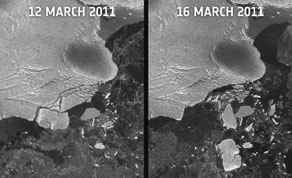
A combination handout image released by the European Space Agency (ESA) of satellite images taken on March 12 and 16, show new icebergs created after the Japan tsunami hit the Sulzberger Ice Shelf. Using radar images acquired by ESA’s Envisat satellite, a Nasa team was able to spot the icebergs, the largest measuring about 6.5km by 9.5km in surface area and about 80m in thickness. The 9.0 magnitude earthquake that stuck off the coast of Japan triggered a tsunami with giant waves. The waves then propagated through the Pacific Ocean over 13,000km south to the Sulzberger Ice Shelf in Antarctica, causing large chunks of ice to break off and float into the Ross Sea. The waves were likely only about 30cm high when they reached the Sulzberger shelf, but the consistency of the waves created enough stress to cause the break off
On March 12, ESA’s Envisat Earth-monitoring satellite spotted icebergs that had broken from the Sulzberger ice shelf, and on March 16, the pieces were seen floating into the Ross Sea, it said.
The largest iceberg measured about 9.5km by 6.5km, making it slightly bigger in surface area than Manhattan, and had a likely depth of about 80m.
The tsunami was at least 23m high after it had been generated by an underwater quake of 9.0 magnitude, according to Japanese estimates published a week after the event.
Analysis of Envisat’s radar pictures by experts in the US suggests that the waves were probably only about 30cm high by the time they had crossed 13,000km of ocean.
Even so, the rhythmic up-and-down movement was enough to stress the ice shelf’s rigid structure, causing chunks to break off at its edge, ESA said in a press release.
Research that linked the tsunami to the iceberg calving was carried out by a team led by Kelly Brunt, an ice specialist at Nasa’s Goddard Space Flight Centre in Maryland.
Their study appears in an online publication, the Journal of Glaciology.
Ice shelves are thick floating beds of ice that are attached to the coastline. They are created by glaciers whose ice is discharged into the sea.