


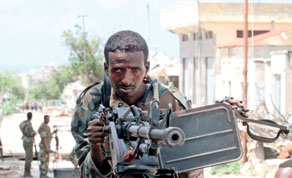
Reuters/Mogadishu
Somalia offered an amnesty to militants still fighting in the capital Mogadishu yesterday, three days after the country’s president declared victory over the insurgent Shebab group, which has withdrawn most of its combatants from the city.

A Somali government soldier keeps guard near Bakara market, south of the capital Mogadishu
It was the first time the interim government, which has struggled to quash a four-year Islamist rebellion, had offered immunity to Shebab fighters.
“The Transitional Federal Government of Somalia (abbreviated TFG) has offered a general amnesty to insurgent fighters remaining in Mogadishu who give themselves up and renounce violence,” the government said in a statement.
Some experts say that Shebab’s withdrawal merely extends the government’s hold on the capital by a few districts, but will do little to bring tangible peace to the rest of the anarchic country and may herald a new wave of Al Qaeda-inspired attacks.
The 9,000-strong African Union peacekeeping force, known as AMISOM, urged the deployment of an additional 3,000 troops to help it secure the neighbourhoods vacated by Shebab.
The UN has authorised a taskforce of up to 12,000 soldiers.
“The Mogadishu area is too large for our present troops to secure properly – there will be some gaps,” Lieutenant-Colonel Paddy Ankunda, AMISOM’s spokesman, told Reuters.
A Western diplomat said the militants’ withdrawal had caught the Somali government and peacekeepers off-guard and warned it was a question of when, not if, Shebab returned to Mogadishu.
“It’s only a question of time before we see them back in a different form,” said the diplomat, declining to be named.
There were fears warlords could step into the void left by Shebab’s departure.
“However, if the TFG overplays its hand and tries to assert a hegemony in the vacuum left by the retreating militants, it risks provoking a very strong reaction by clans and local communities ... to which it has never provided any services,” said J Peter Pham, director of the Atlantic Council think-tank.
The amnesty did not appear to extend to Shebab fighters outside the capital.
The Al Qaeda-affiliated militants control much of southern Somalia where 2.8mn people face starvation because of drought and conflict.
Shebab called its retreat from Mogadishu tactical and said its bloody struggle to topple the Western-backed government would continue.
On Monday afternoon, a suicide car bomb heading for the rubble-strewn capital detonated prematurely 13km south of Mogadishu.
Gun battles raged overnight in at least two northern districts of Mogadishu and residents said government forces and Shebab also traded volleys of mortar rounds.
Mohamed Abdullah, who lives in Mogadishu’s Hosh neighbourhood, said that the militants, who want to impose a strict interpretation of Sharia law on the famine-stricken population, had launched an assault against two government military bases.
“We weren’t expecting such attacks from Shebab now. Clearly the group is still present and still have some power,” Abdullah told Reuters.
President Sheikh Sharif Ahmed arrived in Tanzania yesterday and was expected to hold talks with President Jakaya Kikwete.
There were no details on what they would discuss but Ahmed has already visited Uganda and Djibouti to encourage the delivering of aid within Somalia to stem the exodus of refugees to Kenya and Ethiopia.
Asked whether Shebab’s exit might hasten the flow of aid to the area, the UN refugee agency (UNHCR) said Mogadishu remained volatile.
“You have a vacuum in the (Shebab) areas, and you have competing armed groups who work for their own profit. You have even competing militias in different parts of the town,” UNHCR spokesman Andrej Mahecic told a media conference in Geneva.