


AFP/Kiev
A Ukrainian court has rejected requests to release detained opposition leader Yulia Tymoshenko despite global concern, as the former prime minister defiantly proclaimed her trial was run by the mafia.

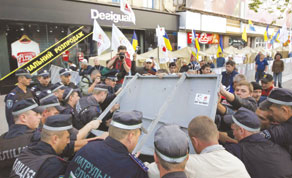
Ukrainian police officers clash with protesters as they try to set up a ferrous fence near a tent camp of Tymoshenko supporters near the Kiev Pecherskyi District Court in Kiev, Ukraine, early yesterday
Judge Rodion Kireyev threw out two motions to reverse Friday’s order to place Tymoshenko under arrest, including an unusual request backed by the head of the Ukrainian Orthodox Church to put her under clerical supervision.
The trial has raised alarm in the West about the rule of law in Ukraine under President Viktor Yanukovich, who defeated Tymoshenko and other leaders of the 2004 “Orange Revolution” uprising in presidential elections last year.
In dramatic scenes, the opposition leader was delivered to court in central Kiev in a prison van hours before the trial was due to open as hundreds of supporters outside shouted “Yulia!” and “Hands off Tymoshenko!”
She yelled “Glory to Ukraine!” as the judge entered the cramped courtroom and showed no sign of softening her uncompromising attitude to the court.
“I will not stand in front of you, because it would be kneeling in front of the mafia. You are not breaking me but Ukraine’s young democracy,” she told Kireyev.
Tymoshenko, who is on trial on charges of abuse of power over gas deals she signed with Russia in 2009, was placed under arrest for contempt of court after describing her successor as “corrupt” and mocking the judge on Twitter.
The authorities have so far made no attempt to remove a camp of dozens of tents set up by her supporters outside the court who were nonetheless watched closely by dozens of police from the elite Berkut anti-riot unit.
Despite spending the last three nights in prison after her arrest on Friday, Tymoshenko was as ever immaculately turned out with full make-up and her trademark hair braid wrapped around her head. She was not in handcuffs.
“Prison is prison but I am not going to complain,” she told reporters and supporters who included priests and her rarely-seen husband Olexander. “This is a test, but it is also the mission of my life, to help Ukraine become a true European state.”
Kireyev however said the defence had presented no convincing argument that her detention conditions needed to be changed and gave Tymoshenko another warning for her “mafia” comment.
He also rejected a second request that was backed by the head of the Ukrainian Orthodox Church Filaret and representatives of the Catholic and Baptist churches.
The hearing also saw witness testimony from Foreign Minister Kostyantyn Gryshchenko, Kiev’s ambassador to Moscow at the time of the gas deals.
Tymoshenko was again rebuked by the judge as she questioned him aggressively.
Tymoshenko says that she is the victim of a vendetta pursued by Yanukovich against leaders of the Orange uprising that annulled a fraudulent election and brought a pro-Western government to power.
EU members and the United States expressed alarm after her arrest, saying they were concerned about a selective prosecution by the Yanukovich-led authorities of their foes.
Ukraine’s first post-independence president Leonid Kravchuk described her arrest in a blog for online newspaper Ukrainska Pravda as an “unjustified, political decision which has inflicted considerable damage on Ukraine”.
Her lawyer Sergei Vlasenko has said he fears she risks being handed a jail sentence of between seven and 10 years.
Yanukovich’s administration has denied having anything to do with the trial.
Tymoshenko is accused of inflicting a 1.5bn-hryvnia ($190mn) loss on Ukraine in 2009 when she signed a gas deal with Russia’s Vladimir Putin that resolved a disruption of deliveries which also affected Europe.
She already has experience of jail after briefly being imprisoned in 2001 on charges that were eventually quashed.
Yanukovich also spent time in jail under the USSR in 1967 and again in 1970 on convictions of robbery and assault.